By Joe Igbokwe, PM News
It is the duty of intellectuals in every society to set agenda for
leaders so that they do not derail. They set agenda so that services
will be delivered as at when due. Intellectuals do not exhibit
intellectual dishonesty; they speak the truth to power always not
minding whose ox is gored. When any society goes astray it is simply
because the intellectuals went to sleep or they have been bought over.
But the real intellectuals do not subscribe to the politics of the
stomach.
The real intellectuals prefer to die of hunger than to
sell their hard earned dignity. Understanding the dynamics of Nigerian
politics has been the biggest problem of the Igbo in Nigeria. The Igbo,
yes my Igbo don’t seem to place a neat handle on Nigeria’s intricate
politics and how well it can be harnessed to improve the lots of the
race. The annulment of June 12 1993 Presidential elections provided an
opportunity for Igbo to join other Nigerians to defend democracy and
rule of law but only a handful of Igbo stood with the Yoruba to defend
June 12. The majority rather chose to be seduced by traders and
illiterates to term the struggle a Yoruba struggle. The struggle for
June 12lasted for five years and the rest is now history. But Yoruba was
not defeated. Presidency was ceded to them for 8 years.
Leadership
failure since 1999 has presented another opportunity for Igbo to work
with other Nigerians to rescue Nigeria from rudderless and inept
leadership PDP has foisted on the country. The Hausa/Fulani sacrificed
ANPP and CPC to join APC. Yoruba moved from AD to AC, ACN and then APC.
Instead of my people joining other stakeholders in the project Nigeria,
they tagged the APC as Boko Haram party, Yoruba party, and Hausa party.
They rather decided to tag slavishly along the despised and failed PDP
and even when a mass exodus has hit the PDP, some Igbo traders and
dancers of fortune feel it is their duty to warm the bed with a dead
child. They eagerly received a dead child like the PDP which in fifteen
years have destroyed the Igbo leg of the Nigerian three legged
structure. From being the one of the three legs of Nigeria before the
coming of PDP, the Igbo are today not even considered one of the sixth
legs of a wobbling Nigeria yet some Igbo mercantilists propped by their
bulging stomach and led in the nose by traders are serving as cannon
fodders to the PDP. This they do, either as direct members of PDP or as
hidden enablers of PDP. APGA has today been turned over to the PDP to be
raped and exploited to its pleasure while the rest of the country moves
to salvage the crumbling nation from the deadly virus the PDP has
become.
The worst is that some so-called intellectuals who should
know and direct the race aright have allowed the rumblings of their
stomachs to make them intellectual pall bearers. They have allowed
themselves to be dragged by barely literate traders and political
harlots to serve at the meal table of the dying PDP, not minding the
odious stenches. They are the most fanatic in defence of the means and
odd ways of the PDP just because such action promises to keep morsels on
their tables. It is a shame!
Igbo nation cannot live in
isolation, Igbo nation cannot be an island unto itself. Igbo need to
work with others, network, interface, negotiate, inter-relate,
synergize, strategize, engage, dialogue and coordinate to make progress.
Until Igbo show that they can be trusted by other Nigerians who are not
Igbo the chances of ruling Nigeria may be remote. Igbo must love the
people they want to rule. If you read ethnic meaning into any project in
Nigeria it may lead to mistrust. To tag APC, Boko Haram party, Hausa
party or Yoruba party is not a good strategy. It is at best a self
defeatist ploy by die hard reactionaries to keep Igbo in perpetual
chains and continue benefiting from the overflowing table of rot the PDP
has employed to wreck and crumble this country for the past fourteen
years. These Amaziahs of the Igbo nation are in a desperate mission to
keep Igbo in perpetual bondage where they will never rise again. They
have been dominant in the Igbo nation since after the civil war and have
been the sole beneficiaries of the decreasing fortunes of the Igbo
nation. It does not show tact, it does not show intelligence, it does
not show commitment or deep understanding of the dynamics of Nigerian
politics.
Political Traders are still choking the development of
politics in Igboland. They still use money to confuse our people. They
have nothing to give Igboland except filling their personal pockets. If
they have anything for Igbo, why is it that in the last fourteen years,
no Igbo man is located within the first six top positions in the
country? Why is it that out people still have no federal investment in
Igboland? Why is it that out people still spend days to cross the sole
bridge over the River Niger? Why is it that we have the worst federal
roads in Igboland? During election time, those that employ them as
internal colonial masters give them money, give them police to come and
manipulate results. After each election, they smile to the bank and ala
Igbo continue to wallow in pitch darkness. They buy up votes and
electoral materials just to be relevant. We have suffered mediocrity in
the name of leadership. These are the fraudsters that bought and
diverted electoral materials in Anambra.The recent electoral fraud in
Anambra can be traced to this factor (the menace of political traders)
Intellectuals must reclaim Igboland and cause our people to rise above
clannish behavior, selfish politics, primordial sentiments, ethnic
preoccupation to join others to reclaim Nigeria.
For the masses of
Igboland, if after fifteen years, we are yet to articulate what we
gained from the same PDP these traders are dragging us to, when will we
start reaping the benefits of the slavish fidelity some political
profiteers have led us to pledge for a dying PDP? If a writer is silent,
he is lying. A school of thought says a story that must be told never
forgives silence. I concur!
•Igbokwe wrote from Lagos
Showing posts with label Nd'Igbo. Show all posts
Showing posts with label Nd'Igbo. Show all posts
Wednesday, December 11, 2013


Sunday, December 8, 2013
Interview with Okwui Enwezor, Director of the 56th Venice Biennale
By Chika Okeke-Agulu, Huffington Post
On Wednesday, December 4, the Press Office of the Venice Biennale announced the appointment of the Nigerian-born curator and scholar Okwui Enwezor as the director of the 56th Venice Biennale scheduled for 2015. In this interview, Enwezor discusses his career and the significance of his latest curatorial project.
Chika Okeke-Agulu: At the opening of Documenta11 in 2002, I remember saying to you that the next big challenge would be Venice. I said it as a kind of joke, but not because I did not think you could do it. Rather I was aware that only one other person--the legendary Harald Szeeman--had curated both Documenta and Venice. In any case, since Documenta you have organized Gwangju and Seville Biennales, as well as La Triennale, Paris, and now, Venice. I cannot imagine what it feels to join Szeeman in this curatorial pantheon?
Okwui Enwezor: Thanks Chika. That's extremely kind of you to make a comparison with me and Szeeman. I know this question will inevitably come up, and I want to be as clear as possible, I belong to no pantheon. There really isn't a comparison; Szeeman is entirely in a league by himself. In the abundance of his ideas, the almost carnal fervor for artists, artworks, and objects of all kinds, along with his bold, original curatorial experiments, he paved the path to the thinking that curatorial practice need not be too studied, formalist or dogmatic.
The fact that we are the only two curators to have helmed both Documenta and Venice Biennale is a historical happenstance; but one who's significance is still settling in. It is of course, a great honor to be entrusted with the task of organizing an exhibition of this magnitude and international acclaim. Nevertheless, it is not lost on me that there is some kind of meaning in the symbolism to which you drew attention. Exactly 15 years ago, I got handed the reins of organizing Documenta. I was 35 at the time, I had limited track record, no major institution, patron, mentor, behind me, yet somehow that amazing jury that selected me saw beyond those deficits and focused, I hope, on the force of my ideas, and perhaps even a little wager on the symbolism of my being the first non-European, etc. My sense of it was that the jury wanted a choice that could be disruptive of the old paradigm but still not abandon the almost mythic ideal of this Mount Olympus of exhibitions.
I came to Documenta as I said with little track record, but with an abundance of confidence. Now at fifty, I come to Venice with a different set of lenses and experience. As you mentioned I have now organized quite a number of biennials. It's time to get to work.
C. O.: Documenta11 was one of the few exhibitions that have been called game changers in the history of curating. And this, I believe had to do with your introduction of the multiple platforms scattered across the globe, as the constitutive sites of an event that until then only took place in Kassel. What are your preliminary thoughts about how you might approach Venice, given its history and structure?
O. E.: It's too early to say what shape the 56th Venice Biennale will take. Of course, I have some preliminary ideas, but those will be worked out in due course. The one virtue of Documenta is the time allowed to organize it, which made possible the platforms. But you must remember that the platform idea, which was fundamentally about the deterritorialization of Documenta, was not initially endorsed by certain landlocked critics, but once it took off its implications about going beyond business as usual became abundantly clear. I drew enormously from the Igbo saying: "Ada akwu ofuebe ekili nmanwu." The mobility of the platforms across major cities and some not so major ones was premised on this principle. To see the artworld properly as it should be, to engage in meaningful debate the curator must risk the sense of inquisitive wanderlust. However, Venice is an Island, but also a legendary maritime trading city that historically looked out to the rest of the world. The limited time permitted to organize the biennale produces a certain sense of temporal density. I am certainly thinking about how to surmount this conundrum.
C. O.: Looking at the trajectory of your career, from the early 1990s when, with a few friends and colleagues working in the margins of the contemporary art world, you founded Nka: Journal of Contemporary African Art, to becoming a leading academic, administrator and curator in the field of contemporary art, does it sometimes feel like an improbable story?
O. E.: All stories are improbable. Nothing is preordained. No one is born with a straight arrow in his quiver. It's a combination of relentless work and good fortune. Without this improbability there is no risk, no adventure, no discovery. I am an autodidact which was the basis of my ceaseless and restless appetite for ideas. I learned enormously about art, not in an art history seminar (I don't even recall actually taking one) but by seeing enormous number of exhibitions, being in the presence of art and artists every week, everywhere. I still do, and I maintain the exercise of seeing, reading, thinking, and writing.
I arrived in New York in late summer of 1982, at a pivotal point in the development of contemporary art, fashion, performance, music, etc. in the city. I was a beneficiary of the perfect storm of creative upheaval: art, postmodern and postcolonial theory, identity politics: race, sexuality, gender, queer and feminist activism, and the AIDS pandemic further refreshed my perspective on difference and politicized my response to injustice. This was the context that opened me up to complexity and to thought me to be courageous and fearless.
Also, Coming from Nigeria I felt I owed no one an explanation for my existence, nor did I harbor any sign of paralyzing inferiority complex. What was apparent was that most Americans I knew and met were actually not worldly at all, but utter provincials in a very affluent but unjust society. And when this became clear I saw no reason why I could not have an opinion or a point of view. I was not about to be respectful of ignorance of Africa or prejudice against African culture. This gave me some chutzpah.
I started learning about what was going on in downtown New York across every cultural and literary sphere through publications like Village Voice, Detail, Seven Days. I attended openings, went to readings, saw an enormous number of exhibitions, in every imaginable context, from apartments to Soho galleries, to alternative spaces to museums, nightclubs such as Danceteria, Area, Pyramid Club, Peppermint Lounge, Palladium, Save the Robots, The World, Roxy, Madam Rosa's, and later Nell's, Mars, you just name it. I was educated as it were in situ. I can actually say that I was there.
At some point this intense experience as a young Nigerian who was deeply interested in art and all types of the creative process ceases to be a fluke. I don't believe in standing on the margins. You should also know that what partly made Nka viable was that I did actually have a deep knowledge of international contemporary art. I was not pretending. When I started thinking of setting up Nka in 1991 when I was in my twenties, I was intellectually ready and had a certain theoretical grounding and immersion in art, visual culture, etc. I was already collecting a bit of photography and some art. My first major acquisition was the portrait of Jean-Michel Basquiat by James Van der Zee from Howard Greenberg Gallery on Wooster Street. I would go to the Comme des Garçon boutique downstairs to shop and up to the Greenberg Gallery to browse vintage prints by Cartier Bresson, Kertescz, Weston, Moholy Nagy, Baron de Meyer. So with Nka It wasn't as if I did not know what I was talking about. The only reason it also worked was because I had the language and it was fresh and people were open to giving it audience. That it led to where I am standing today is both surprising and thrilling. But we are nearly thirty years into this story. The novelty of endless looking back is wearing off. Obama's campaign slogan in the last election against the hapless Mitt Romney had it exactly right: Forward.
C. O.: Are you going to retire from curating biennales after Venice?
O. E.: I am not the retiring type.
On Wednesday, December 4, the Press Office of the Venice Biennale announced the appointment of the Nigerian-born curator and scholar Okwui Enwezor as the director of the 56th Venice Biennale scheduled for 2015. In this interview, Enwezor discusses his career and the significance of his latest curatorial project.
Chika Okeke-Agulu: At the opening of Documenta11 in 2002, I remember saying to you that the next big challenge would be Venice. I said it as a kind of joke, but not because I did not think you could do it. Rather I was aware that only one other person--the legendary Harald Szeeman--had curated both Documenta and Venice. In any case, since Documenta you have organized Gwangju and Seville Biennales, as well as La Triennale, Paris, and now, Venice. I cannot imagine what it feels to join Szeeman in this curatorial pantheon?
Okwui Enwezor: Thanks Chika. That's extremely kind of you to make a comparison with me and Szeeman. I know this question will inevitably come up, and I want to be as clear as possible, I belong to no pantheon. There really isn't a comparison; Szeeman is entirely in a league by himself. In the abundance of his ideas, the almost carnal fervor for artists, artworks, and objects of all kinds, along with his bold, original curatorial experiments, he paved the path to the thinking that curatorial practice need not be too studied, formalist or dogmatic.
The fact that we are the only two curators to have helmed both Documenta and Venice Biennale is a historical happenstance; but one who's significance is still settling in. It is of course, a great honor to be entrusted with the task of organizing an exhibition of this magnitude and international acclaim. Nevertheless, it is not lost on me that there is some kind of meaning in the symbolism to which you drew attention. Exactly 15 years ago, I got handed the reins of organizing Documenta. I was 35 at the time, I had limited track record, no major institution, patron, mentor, behind me, yet somehow that amazing jury that selected me saw beyond those deficits and focused, I hope, on the force of my ideas, and perhaps even a little wager on the symbolism of my being the first non-European, etc. My sense of it was that the jury wanted a choice that could be disruptive of the old paradigm but still not abandon the almost mythic ideal of this Mount Olympus of exhibitions.
I came to Documenta as I said with little track record, but with an abundance of confidence. Now at fifty, I come to Venice with a different set of lenses and experience. As you mentioned I have now organized quite a number of biennials. It's time to get to work.
C. O.: Documenta11 was one of the few exhibitions that have been called game changers in the history of curating. And this, I believe had to do with your introduction of the multiple platforms scattered across the globe, as the constitutive sites of an event that until then only took place in Kassel. What are your preliminary thoughts about how you might approach Venice, given its history and structure?
O. E.: It's too early to say what shape the 56th Venice Biennale will take. Of course, I have some preliminary ideas, but those will be worked out in due course. The one virtue of Documenta is the time allowed to organize it, which made possible the platforms. But you must remember that the platform idea, which was fundamentally about the deterritorialization of Documenta, was not initially endorsed by certain landlocked critics, but once it took off its implications about going beyond business as usual became abundantly clear. I drew enormously from the Igbo saying: "Ada akwu ofuebe ekili nmanwu." The mobility of the platforms across major cities and some not so major ones was premised on this principle. To see the artworld properly as it should be, to engage in meaningful debate the curator must risk the sense of inquisitive wanderlust. However, Venice is an Island, but also a legendary maritime trading city that historically looked out to the rest of the world. The limited time permitted to organize the biennale produces a certain sense of temporal density. I am certainly thinking about how to surmount this conundrum.
C. O.: Looking at the trajectory of your career, from the early 1990s when, with a few friends and colleagues working in the margins of the contemporary art world, you founded Nka: Journal of Contemporary African Art, to becoming a leading academic, administrator and curator in the field of contemporary art, does it sometimes feel like an improbable story?
O. E.: All stories are improbable. Nothing is preordained. No one is born with a straight arrow in his quiver. It's a combination of relentless work and good fortune. Without this improbability there is no risk, no adventure, no discovery. I am an autodidact which was the basis of my ceaseless and restless appetite for ideas. I learned enormously about art, not in an art history seminar (I don't even recall actually taking one) but by seeing enormous number of exhibitions, being in the presence of art and artists every week, everywhere. I still do, and I maintain the exercise of seeing, reading, thinking, and writing.
I arrived in New York in late summer of 1982, at a pivotal point in the development of contemporary art, fashion, performance, music, etc. in the city. I was a beneficiary of the perfect storm of creative upheaval: art, postmodern and postcolonial theory, identity politics: race, sexuality, gender, queer and feminist activism, and the AIDS pandemic further refreshed my perspective on difference and politicized my response to injustice. This was the context that opened me up to complexity and to thought me to be courageous and fearless.
Also, Coming from Nigeria I felt I owed no one an explanation for my existence, nor did I harbor any sign of paralyzing inferiority complex. What was apparent was that most Americans I knew and met were actually not worldly at all, but utter provincials in a very affluent but unjust society. And when this became clear I saw no reason why I could not have an opinion or a point of view. I was not about to be respectful of ignorance of Africa or prejudice against African culture. This gave me some chutzpah.
I started learning about what was going on in downtown New York across every cultural and literary sphere through publications like Village Voice, Detail, Seven Days. I attended openings, went to readings, saw an enormous number of exhibitions, in every imaginable context, from apartments to Soho galleries, to alternative spaces to museums, nightclubs such as Danceteria, Area, Pyramid Club, Peppermint Lounge, Palladium, Save the Robots, The World, Roxy, Madam Rosa's, and later Nell's, Mars, you just name it. I was educated as it were in situ. I can actually say that I was there.
At some point this intense experience as a young Nigerian who was deeply interested in art and all types of the creative process ceases to be a fluke. I don't believe in standing on the margins. You should also know that what partly made Nka viable was that I did actually have a deep knowledge of international contemporary art. I was not pretending. When I started thinking of setting up Nka in 1991 when I was in my twenties, I was intellectually ready and had a certain theoretical grounding and immersion in art, visual culture, etc. I was already collecting a bit of photography and some art. My first major acquisition was the portrait of Jean-Michel Basquiat by James Van der Zee from Howard Greenberg Gallery on Wooster Street. I would go to the Comme des Garçon boutique downstairs to shop and up to the Greenberg Gallery to browse vintage prints by Cartier Bresson, Kertescz, Weston, Moholy Nagy, Baron de Meyer. So with Nka It wasn't as if I did not know what I was talking about. The only reason it also worked was because I had the language and it was fresh and people were open to giving it audience. That it led to where I am standing today is both surprising and thrilling. But we are nearly thirty years into this story. The novelty of endless looking back is wearing off. Obama's campaign slogan in the last election against the hapless Mitt Romney had it exactly right: Forward.
C. O.: Are you going to retire from curating biennales after Venice?
O. E.: I am not the retiring type.
Wednesday, May 8, 2013
Anaocha Community launches free Igbo lesson for schools
In its quest to revive Igbo language in non-Igbo speaking states of the federation, Indigenes of Anaocha Town Union in Lagos State have unveiled plans to organise free Igbo Language lessons for children in various schools.
The President, Association of Indigenes of Anaocha Town Union (AIALG), Mr Martins Ileme, stated that a survey conducted by the union revealed a large number of children living in non-Igbo speaking states, born by Igbo parents, who hardly speak their native language.
He expressed shock that some of these children end up registering Yoruba and Hausa languages in their Senior School Certificate Examination (SSCE) at the expense of their local language.
Ileme described as worrisome the loss of interest in Igbo Language in most schools attributing the situation to incompetent teachers and the policy of some private schools that restrict students to only one local language.
He said the union would continue to promote programmes that will encourage the younger ones to appreciate the richness of Igbo language and culture.
He said new yam festival would also be introduced in Lagos by the town unions to celebrate the cultural heritage of Anambra people and educate their children further on the historical values of their home state.
Towards this end, Ileme said an education trust fund would soon be instituted by the union to encourage positive interventions in needy schools. According to him, part of the fund would cover scholarships for students at various stages of learning.
------Vanguard
Wednesday, March 6, 2013
Igbos, Think Home!
When, in the immediate post-Nigeria/Biafra Civil War years, Ukpabi Asika, then administrator of East Central State, told his fellow Igbos that “amnesty does not mean amnesia”, he meant to remind them that though the victorious Federal Government (or the rest of Nigeria, if you like) may have forgiven them, it certainly hasn’t forgotten – and it may never forget. But would he have envisaged that decades later, the Igbos would, unfortunately, themselves relapse into amnesia, forgetting totally the hard lessons of that brutal war? I doubt so.
I do not wish to return in detail to the various ways the Igbos have exhibited their collective amnesia since the civil war ended. I have amply dwelt on that in an earlier article “Are Igbos suffering from collective amnesia?” which is available online. The bottom line is this: huge Igbo investments are scattered in all parts of Nigeria with the exception of Igboland. Igbo people are all over the place contributing to socio-economic development while Igboland remains grossly underdeveloped.
There is a sense in which one can argue that the civil war experience – particularly the ‘abandoned property’ saga – did inculcate some sense of responsibility into the Igbos. Many of them who had lived in fine mansions in the cities where they had established themselves prior to the war returned home as refugees to squat in mud houses with their relatives in the villages. Reason: they had no homes in their homeland. That sad experience brought about a new thinking – aku ruo ulo (literally, let the wealth be felt at home). The Igbos learnt to take part of their wealth to their native land – in the form of community development projects through the town unions, as well as big mansions. But that did not seem to have lasted for long before they reverted to their pre-war ways.
To re-echo the optimism of many a Nigerian leader, this country won’t break up – and nobody prays it does. It’s not our portion (permit me to go Pentecostal just this once), but supposing, just supposing, considering the vagaries of our daily existence in this hole of a country, something happens to Nigeria right now? Sorry to say, but given the unquantifiable loss the Igbos have suffered, in man and material, in riots across Nigeria since 1953, it would be most tragic if, this time around, the Igbos are caught napping, with all their eggs in one wrecked basket.
Igbos are a migrant people. That’s given. It’ll sound unnecessarily repetitive to restate the oft echoed sentiment that wherever you go and don’t find an Igbo person, then that place must be uninhabitable. Writing as early as 1957 in West Africa: A Study of the Environment and Man’s Use of It, R. J. Harrison Church did assert that the “Ibo are found in temporary work all over Nigeria, and some 20,000 are employed in Fernando Po”. The Igbos have never looked back ever since; not even the events of 1966-70 could hold them back.
As it is, it’s obvious, given their stakes in their various host communities in other parts of Nigeria, that the Igbos cannot possibly return home en masse – permanently. That can’t and won’t happen – not even for those Igbos living in the flashpoints of northern Nigeria. It’s not even desirable at this point. Of course, Igboland cannot even contain all the Igbo people were they to suddenly return home. Igboland is a land-hungry area. Land hunger was part of the reasons the people emigrated out of their traditional homeland in the first place. What can be done for now is for the Igbos to begin to consider taking part of their investments home. It may not be economically viable at first, but it will be, over time, and it’s something worth doing, however you look at it. I often imagine what Igboland would be if just a quarter of Igbo investments in Lagos alone is brought back to Igboland!
We can take a cue from the fact that there are many foreigners living and doing business in Nigeria who make huge profits here and repatriate their profits to support the economies of their home countries. Nigerians in other parts of the world are also known to do the same. In 2012 alone, it is estimated that remittances from Nigerians in Diaspora into the Nigerian economy are in excess of N3 trillion. Who says Igbos in other parts of Nigeria (and the world) can’t do the same for Igboland?
But first, the governors of the five South-East states must work consciously and painstakingly to woo rich Igbo Diaspora back to Igboland. All this empty media hype won’t go anywhere. The Indian model may be instructive here. Every year, the Indian government organises Pravasi Bharatiya Divas (Expatriate Indians’ Day), an annual jamboree of Diaspora Indians, which is also used to attract expatriate investment. The Indian government can do this because it places great premium on its Diasporans and what they can contribute. Shashi Tharoor, India’s minister of state for human resource development, admits: “The importance of diaspora financing – from the remittances of working-class Indians that have transformed Kerala’s countryside to the millions poured into high-tech businesses in Bangalore or Gurgaon by Silicon Valley investors – simply cannot be minimised, especially during a global financial crisis.” Yet, Tharoor makes a case for encouraging the Diasporans to do more, and giving them reasons to do more, because “when India allows its pravasis to feel at home, India itself is strengthened”. The South-East governors can take a leaf from this.
For their part, the Igbo Diaspora also have to show a willingness to come home to develop Igboland. Then they can begin by engaging their governors. The onus, as I’ve said, is on the governors to create the enabling environment in their various states to attract rich Igbo people to invest back home, but what if these governors lack the ideas? This is why the Igbo Diaspora cannot wait eternally for the governors. They can, as in the saying, be the mountain that goes to Muhammad. Igbos have developed swamps in the west and deserts in the north for too long, but that hasn’t moved Igboland an inch out of gross underdevelopment.
One other option for Igboland is to toe the line of regional integration that has become a fad across the country. As I have argued elsewhere, “To say that the states of the South-East need economic integration as much as other regions of the country – or even more so – is merely stating the obvious. There is no doubt that the South-East is among the least developed areas of the country – if not the very least – in terms of infrastructure, which is worsened by the virtual absence of federal projects in the region. This is one reason the Igbos of the South-East are scattered in all parts of Nigeria and the world where they contribute immeasurably to development, while their home region remains a backwater. Joining forces will likely reverse this trend. Working together, the South-East states, rather than wait eternally for a sleeping – or politics-playing – Federal Government, can pool resources and commence work on the direly needed Second Niger Bridge and such other projects, rehabilitation of the badly damaged interstate roads in the region, and development of other infrastructure that would bring the Igbos back home to invest.”
While these things may not be as straight-forward as I present them, and while I can’t claim that this is the final word, I believe it’s a starting point. Let others who have the good of Igboland at heart join this debate. Who knows, we might still be able to redeem Igboland from its present calamitous state; we might still be able to wrest Igboland from the grip of kidnappers, armed robbers and other criminals who have made visiting home a nightmare for many (especially since some pundits believe these crimes are rooted in the widespread joblessness in the land); and we might still be able to move all these Ebonyi children hawking all-what-nots at every bus stop back to their state where they can contribute more meaningfully to the development of both themseves and their state. So help us God.
Saturday, August 4, 2012
Film Shows Epic Journey Of Nigeria's Jews

By JOE DOWD/PLAINVIEW PATCH
An epic cinematic journey that reveals a link between ancient Jewish culture and the people of modern Nigeria will have its Long Island premier next month in Plainview.
The Manetto Hill Jewish Center will host the screening of “Re-Emerging: The Jews of Nigeria” on Sunday, Sept. 9, 2012 at 7 p.m.
The entire community is invited.
Jeff Lieberman's film, which has showings this weekend in North Carolina and Australia, will be in attendance at the Plainview event to discuss his work.
From a historical perspective, the documentary's revelations are stunning:
The film follows the journey of Shmuel, a young Nigerian Jew, who uncovers his Judaic roots as a member of the Igbo clans in Nigeria. Using the Internet, the young man realizes the similarities between his culture and Jewish traditions. His story reveals an ancient link of Nigeria's Igbo who are now re-connecting with their Jewish roots.
Experts trace the Igbo people from Biblical times through the Biafran War of the 1960s, when more than a million Igbo were killed.
The film's saga transcends geographic boundaries: Countless African-Americans of Nigerian descent may be connected to the Igbo people and share their Jewish heritage, the film asserts. Igbo people were enslaved by the thousands by Western traders and transplanted in the New World.
"The film is a riveting documentary film which has received international acclaim," said Marilyn Morris, a member of the MHJC's membership committee. "The filmmaker has expertly captured the stories, history and real life pictures of the lives and culture of the Igbo people."
A short film trailer can be seen on the film's website: http://re-emergingfilm.com/Video.html
The entire community, regardless of religious affiliation, is invited to attend the Sept. 9 screening, synagogue leaders said.
NIGERIA: 2015 Presidency: 'I Weep For The Southeast People'

GUARDIAN NIGERIA INTERVIEW BY SAMSON EZEA & NKECHI ONYEDI
PROF. A.B.C Nwosu, former Minister of Health and chieftain of the Peoples Democratic Party (PDP), speaks on the state of insecurity in the country, Igbo Presidency in 2015, corruption and other issues.
The Igbo are clamouring for the Presidency in 2015, do you think it would be possible?
People get the leadership that they deserve, but the Bible also says that where there is no vision, the people perish, I weep for the Southeast and beyond, I won’t say more. There are people who promised the Ohanaeze leadership that power will go to Southeast in unbroken succession in 2015 from the Southsouth, that was their solemn word and that was what the Ohanaeze leadership told Ndigbo last year. So, we must hold them to their words if not, and the people should disgrace them thoroughly, because if we don’t disgrace them, another set will come up again. When a leadership says this is what they will deliver and they don’t deliver it, the followership should sanction them.
What were the factors that hindered previous moves by the Southeast to clinch power in the country?
The Igbo got the first Presidency of Nigeria, but it was a ceremonial president during the time of Dr. Nnamdi Azikiwe. It has not always been like this with the Igbo. After independence, it was Azikiwe until 1966. The situation changed when we had the executive president in 1979, after the civil war had intervened. There is a school of thought that believes that the Igbo, having fought the civil war, should never be allowed to be President again until centuries have passed. There is also another school of thought that says ‘no, the Igbo have paid their dues and are entitled to the exercise of their full citizenship rights, including the Presidency’. The Igbo believed they must produce the President and in 1979, they came near it with Chief Alex Ekwueme as Vice President. Perhaps, if the military hadn’t intervened in 1983, Ekwueme might have become the President at the end of Shagari’s second term, but the military intervened and later there was June 12 presidential election, which was won by the late Chief MKO Abiola. Because of that, in 1999, it had to be exclusively Southwest issue.
Now, the Igbo are saying that they also need to become part of the equation and they reached an agreement with the Southwest, South-south in 2007 that the we didn’t mind if a Southsouth was, that was why some of us gave Dr. Peter Odili our best support in his presidential quest in 2007. Now that the Southsouth has produced the President, the only people who have not produced president is Southeast and we are saying we should produce. We are not anti-anybody, we are just pro-Igbo.
I respect the Yoruba the way they canvassed, pushed and held on to June 12. They are a people, they didn’t have to agree, but they made June 12 an issue and Nigeria recognised that June 12 was an issue. They presented a credible threat and were recognized.
I salute people like Chief Edwin Clark, though I will not go with him, but I salute him for his spirited defence of his people. He is a soldier of his people and a defender of Ijaw rights and I respect his tenacity. Because of that and the resource control issue, they also presented a credible threat and have become a force in Nigeria and Nigeria has recognised them.
But my heart bleeds when it comes to the Igbo, and then I weep again for the late Ikemba Odimegwu Ojukwu. And I ask, when will some leaders emerge from Igbo and say, ‘this is us, we mean no harm, but we are citizens of Nigeria and are entitled to full citizenship as a right’.
Not for people to be looking for where they are sharing porridge and running into the place, collect plates of porridge and vanish. It has always been an issue and each Igbo man must choose what he wants.
What is your view on the proposals submitted by Ohanaeze leadership on the amendment of the country’s constitution?
I needed a tranquilizer when I saw the president general of Ohanaeze Ndigbo presenting a proposal to the Deputy Speaker of the House of Representatives.
I have four issues with that; if you are presenting a proposal on my behalf, at least, I ought to know what it is, it was in the pages of the newspapers that I heard that it was a six-year single term and I know it flies in the face of what Ndigbo has been asking for. My first quarrel was: why don’t they let our people see what they are submitting their behalf? How did they arrive at the decision? They can’t just wake up and begin to act as if nothing else occurred before now? I saw the one submitted by Delta State which was published in the newspaper. It was specific that Federal powers must be devolved to the states and it quoted specific sections of the constitution that they want to be amended.
I am not saying that they shouldn’t do it, but it will be easier if they carry everybody along and publish the proposal on the pages of the newspaper. Nothing will be lost because this thing is not a secret document. The Igbo people are not seeking something that is anti-Nigeria.
Many believe that corruption has worsened in the country since 1999 and the government is not doing enough to curb, do you agree?
I was shocked on May 29, 1999 when President Olusegun Obasanjo appointed me as Political Adviser and brought me into his government without knowing me.
We had never met as at that time, he had never seen me and I remembered that we went into the small room in the Villa after we congratulated him. I told him that I am Prof A.B.C Nwosu, he held me and took me into the small room and said, he wanted me to work with him and he had two bills with him that day he was sworn in. The Bill on Niger Delta Development (NDDC Bill). I will always say the truth, if anybody says it is an afterthought from Obasanjo, it is not true. He came to the Presidency determined to set up the NDDC to redress the injustice meted to the Niger Delta. How he ended up, he will be in the best position to tell us, but I know he showed me the Bill.
The second bill he showed me was the Anti-Corruption Bill, and he wanted me to do a research on how countries of the world had dealt with corruption and set up their anti-corruption agencies and the kind of powers they have.
The most charitable thing I can say is that corruption is still with us, and it illustrated what the Igbo man wrote on his motor that ‘to be a man is not a day’s job’. To fight corruption in Nigeria is not a day job, because corruption will fight back. So we have to fight it, if we don’t fight it, it will undo us as a nation. It diminishes our sovereignty and ability to fulfill our destiny in the world, so we must fight it.
Let’s forget yesterday, let’s start from today. This current Senate has identified wrongdoings in the privatization; we can fight it by doing something about that. We can look at the report, it is a report from our Senate, we can deal with it, we can deal with the corruption witnessed in the pension probe, it is mind-boggling. That brings us to the subsidy scam. What can stop corruption is that anybody who is caught in corruption is arraigned and jailed in accordance with the law. That is why you see people looking for General Muhammed Buhari; he sentenced people to unbelievable jail terms which they served some. If you catch a person, you send him to jail and make him forfeit some of those property and people see it.
What is your reaction to the state of insecurity across the country today with the killings in Jos and Boko Haram?
Everybody is worried, including the security agencies. My problem is that worrying about this cannot give us security. It is doing something about it that will give us security and I want to suggest that we can do something about it by engaging traditional rulers. Not just in places where we have security problems, but also all over the country.
I am convinced that we all have a firm resolve that the security problem cannot go on anymore, because I don’t think there is anybody who is benefitting from it. The problem is diminishing Nigeria’s sovereignty.
For somebody who witnessed the civil war, it is frightening. The thing has gotten out of hand and out of control and the only way to control it is to engage the traditional rulers and the various stakeholders. It is not of religion, and it is a matter of sovereignty, nationhood and citizenship.
We need to be firm about how the coercive agencies of the state are handling this matter. Murder and arson are criminal offences of the worst order. We have a proverb that says, “ If a small child craws and bites an old man without respecting the grey hair, the old man should craw back and bite the child on the buttock without respecting whatever he sees there.”
So if these people kill and maim people, the coercive agencies should use maximum force to establish the sovereignty of Nigeria. This insecurity issue has gone so far that it has to be dealt with decisively now.
Is the high rate of unemployment in the country a contributory factor to the problem?
Unemployment is a major factor because an idle mind is the devils workshop. The level of unemployment is intolerable and nobody is happy with it, but there are people who are paid by government to think out programmes that will keep people employed in a sustainable manner.
We cannot import tricycles popularly Keke NAPEP from India and tell a graduate of Chemistry to be driving and say it’s employment. What we are facing in the world is not new, America and Britain have gone through depression and a major way of creating employment in a sustainable manner is through massive investment in public works.
If government decides now to build one million housing units in Nigeria today, do you know the number of people who will be employed? Not Keke NAPEP for God’s sake. Or this thing they are doing, call young boys and give them lectures, after the lectures, they give them N5 million and ask them to go and be entrepreneurs and employers of labour. That again to me is again laughable. We should have a way of encouraging small and medium scale industries in a measurable way.
The Nigerian market is huge, we don’t have to export, we have over 160 million people. If we make enough quality goods and people buy into it, it is enough to create employment. The one that my heart bleeds as I drive to Enugu is the Ajaokuta steel. There are so many buildings that have passed lintel level, they have been wasting away for over 20 years. Ajaokuta is not only a steel factory, it is steel city. That is why you have hospitals, residential quarters and others there.
Ajaokuta Steel can conveniently absorb thousands of unemployed youths. Why should we leave the fate of people like that to some nonsensical privatization which every probe has found wanting.
I was one of the authors of the PDP manifesto, we believed in private sector-led economy, but we did not say that we would auction off the entire economy to whatever private sector. We have no national carrier, how many countries do you know that don’t have national carriers? Because of private sector, they go and bring 30-year-old aircrafts into Nigeria airspace. That is a shame.
This is 13 years of Democracy in Nigeria, do you think we have done well?
I laugh whenever I hear that US spent 200 years before they got to where they are today. The issue is that people learn from people’s experiences, so that you don’t have to go through the same thing. We have more than enough time. What are we learning that nobody should rule another person without the persons’ consent? When you rig the election, you are ruling without the consent of the people, is that what you need 500 years to learn? Do we need 500 years to draw up people’s constitution?
Monday, October 31, 2011
[Nigeria] Nd'Igbo, Persecution, Etc. and Random Thoughts
I am not the only one who had thought the whole idea was crazy, even though I had overlooked it as a rhetorical garbage, hearing about it as a speculation and what the news outlets had gathered.
I am not the only one who felt the pain that a brother in a new line of attack wants his own brother permanently out of his face.
And I am not the only one who had seen the order from Theodore Ahamefula Orji’s administration in Abia State asking non-indigenes of the state to leave his government office jobs alone drawn from the deadly Boko Haram incidents Vanguard’s Pini Jason called ‘Tufiakwa,’ an outright abomination in Igboland.
I am not the only one who had thought the decision of a 21st Century persecution of a group of people profiled for some inexplicable events I’m yet to fathom, was bizarre and should be condemned in its entirety.
And, for sure, I am not the only one who is seeing the ridiculous measure as a tactic to change its subject, hijacking the peoples mandate to run a regime typical of banana republics.
And what would have amounted to such unimaginable action as a move beyond reasoning by Orji asking non-indigenes in his state to leave his civil service alone?
If this clueless ‘executive’ and his action is not an indication of madness and psychological problems, I don’t know what else is.
After giving a thought to Orji’s weird decision, I had hoped it was like another sensationalized story and, thus have this to say: One, I really hope Orji’s cabinet reverses its decision. Two, I hope the decision is not true and had been taken out of context through its legislative process before becoming law. Three, I hope it’s like one of the practical jokes picked up by the tabloids targeting its reading audience for some cheap shots. Four, if indeed it’s true that Abia State had a plan to sack her own kith and kin from a land that was once one entity and a land once a whole before the mean strategy of divide and rule by the colonization powers and military juntas, Igbo, then, should forget about its own national state. And five, if as it has become true and all the Igbo-related states are now bent, watch the forbidden decision unfold in Abia, and do nothing by way of mass movements - demonstrations, sanctions and other related measures to proclaim Abia a pariah state - Igbo should forget its national state, living as predicted and appears; a peoples disappearing cultural heritage and natural being, coupled with the landscape that identifies it as a national state.
That would mean Igbo is done with its nationhood, eventually. It would mean no such thing as Igbo. It would mean Igbo would be extinct as a people, evolving to a blend of other people, culture and languages. And it would mean what its culturally heritage rivals had haggled on, over time in terms of its exceptional culture and tradition, that Igbo never had a unique culture, was never distinct as had been thought, which evidently had become the simple truth.
It is pointblank in this regard that no one should come after me as in the past on my essays, reports and views which caused all sorts of outrage from related events over time, and the analysis following the thoughts I had penned into perspective; issues concerning Nd’Igbo and how to screw in the nuts and bolts needed for a permanently structured place, appropriately. As those thought-provoking papers were directed toward effective leadership which had been lacking, measuring the capability and the capacity of the seriousness in which organized people gets things done. Even though it came with reasonable and logical responses from a very few on the subject matter, many, beyond imagination, chipped in with their ideological views, unrelated and incoherent to the topic in question with quantities of angry mail that flooded my mail box. Some of the bunch were sociological anger by its expression. “Who is it you are writing for?” How much are they paying you for all these your write-ups?” “You have been sent to destroy my political career.” “When you collect, you write good and when you don’t collect, you criticize.” “What did Nd’Igbo do to you?” “I like the way you write but people are complaining that you only criticize Nd’Igbo,” read some of the angry mails and comments.
And with all that hate mails popped out due to the magic pen I had used to write about a peoples social ills, not too many are now raising hell to the line of profiling, bigotry and hatred instituted by the government of Abia State on a people it shares the same lineage. A people culturally and linguistically bonded. A people known to have shared the same ancestors. A people commonly bonded by way of its worship until the advent of the missionaries and the colonial mandates; and a people that have lived, prayed and worked together for onward objectivity.
Many are now tight-lipped for having nothing to say on a variety of reasons - not wanting to be disturbed - being preoccupied with personal obligations, got bills to pay, not the one to fix Igbo problems, none of “my” business and besides, “they should put their own acts together,” and things like that.
Many do not want it mentioned in their face, the in-your-face kind of attitude, for problems heavily accumulated and problems requiring little or nothing, best known to them. Gestured moves like, I don’t have a job and why should I be worried about something that is not going to fetch me a job or pay my bills. Who cares and why couldn’t those non-indigenes stay in their respective states of origin or relocate elsewhere no such laws of eviction exists? Why are all the brouhaha news when there are numerous overwhelming challenges facing them ahead? Why are they in such a bad shape, anyway, and why would all these nonsense stick out when the sitting governor was not legitimately elected in the first place?
Many are moving on, doing their own thing as it pleases them; for their property, life and wealth comes first before any social ills sort of, that will not contribute to their welfare.
Many gave a thought to Abia State’s newest proposition, writing and talking about it as a taboo and should not be allowed to be implemented in the said state; for it would ruin the foundations of Igbo cultural heritage.
And many, as obviously may have been the case, indicated the sanction did not target Igbo indigenes but non Igbo indigenes, and no matter what the decision may have seemed to be, that it included Nd’Igbo on its eviction notice to proclaim the action was not bias, and that realistically, no Igbo had been affected or evicted from the state’s franchise following the strange decision.
Nevertheless, when a government respects the rule of law, upholding democracy its legislative body makes, it should be known that a legislative process in any democratic order involves representations from districts/zones in which proposals are tabled or set in motion for legislation, and when passed on the terms of required figures favoring the proposition which then becomes law, and despite the negating party which may be short of gridlock or fails to garner enough counts to kill such proposition, the yays takes it away, thus making its sponsored motion law, as in all democracies, unless otherwise.
So, as it happened, Abia State in what it had claimed as events that led to evict non indigenes from its governmental offices, the Boko Haram terrorists, it saw threatened the state from its relative bombings elsewhere which ignited the deal of persecution and justifying it with action “timely taken” by Governor Orji.
Persecution had been a classic case of human endeavor. But persecuting a cousin is way out of fashion. I would have been less worried if the Abia State government had been concerned on the mounting pressing problems in the state - widespread scandals of kidnapping, rape, assassinations, civil unrests resulting from related socio-economic problems as part of unending tragedy in the state, rather than its new measure, taking its woes on a people of its kind, moving to where they find life sustainable and comfortable.
In analogy to persecuting people on reasons of faith, language, religion, culture, economics and what have you - the Spanish Inquisition; Adolf Hitler’s persecution of Jews and Gypsies in Europe; and persecutions in related African countries, draws Abia’s “non-indigenes must go” into perspective with a whole lot of questioning, though.
“If we had some sense of shame, I mean even a little, some people called traditional rulers in the state should know they have no business in this matter, and it is totally out of place for them to log unto this dirty side of politicking to champion a cause,” writes Ikenna Emewu (Daily Sun). “So base and inane as this discriminatory policy of a state against its own blood. If indeed, this list of traditional rulers – about 10 of them and some others in the list is real, I really sympathize with the communities they rule.”
The traditional rulers had been something else but total blame should be irrelevant when a cast of administrative personnel lumped together would endorse an arbitrary measure which makes it scary. The traditional rulers, to be precise, are the architects of destruction in Igboland, in every aspect of its civil liberties, even though the enlightened ones among them sit idly and watch these ridiculous measures unfold. What unfolded in Abia State should not be of a “stunning gig “ based on how Ndigbo operates, remarkably with the traditional rulers who have no business in a just, representative and accountability government but the desire to put in monkey wrench to cause havoc in every of its dealings, adding insult to dishonor. And on the claim that Imo was not nice to Nd’Abia on the breaking down and carving out of the state from a previously dissected Eastern Region to East Central State, to Imo State - Yakubu Gowon and Murtala Muhammad military juntas - a plot orchestrated to keep Igbo divided; which should be taken that Abia had declared its isolation from Igbo in its entirety and no longer care..
The point is, nobody seems to be paying attention as to where Orji’s executive order may lead to and when that decision had been to kick the rest of Nd’Igbo out from its civil service, that could also be making a whole lot of stuff clear for Nd’Igbo: that, say, for instance, an Arochukwu is being savagely axed or murdered in the most brutal way, and a fellow Igbo who stood by watch the horrific event take place must not be questioned or blamed in an act of feud across state lines among brothers, because Orji had fired the first shot in what would be a long battle of a brothers war. That when an ethnic slur is rained against an Ngwa at a market square, it would be fine to cheer on remarks of bigotry and hatred, because Orji started it all. That assuming a Bende man got into squabbles of civil unrest in the northern landscapes and about to be lynched for simply being Igbo while an Igbo at the scene could have intervened but didn’t on the grounds of an irrational executive order by Abia State government.
As the list goes, that an Abriba girl happens to be hijacked by a gang of cultist rapists and another Ihiala man was well positioned to have stopped the rapists and wouldn’t do it just to retaliate by way of personal vendetta, getting even as a result of the actions by Abia government against Nd’Igbo. That an Mbano trader could not meet a fellow colleague of Njaba descent on business related talks over pounded yam and ofe olugbo, bitter leaf soup, at an eatery around the block because the restaurateur hails from Ohafia.
Or as we may have discovered the tragic events of our time, that Nd’Igbo whose history has been of political impotence and victims of genocidal campaigns; and all of a sudden, the northern Islamic Jihadists and terrorists begins to sound positively bloodthirsty again, as in the Sharia Debacle of 2000, and had turned en masse against Igbo women, men, children and their properties in another cycle of wanton killings, and demolitions; and as in a new balkanization theory begun by the state of Abia which would justify the gruesome acts of the Islamic “Jihadic” nihilists and hoodlums on the basis “Igbos have no business to where they don’t belong” in supposedly a Nigerian national state having no restrictions on the free movements of peoples.
What message would Abia State be sending to the rest of the nation when it creates a platform encouraging the northern Islamic terrorists that its acts of terrorism is justified for the purpose of deliberately eliminating its own kind by walling.
Igbo, from generations, not even recorded, has been spoken within the borders in predawn Southern Nigerian Protectorate, a colonial schedule by fabrication - Umunede, Agbor, Asaba, Okpanam, Okitipupa, Igurita, Auchi, Lagos, Abeokuta, Omoku, Ikwerre, Ogoni, Bonny, Okirika, Nando, Ugep, Adadama, Degema, Ogoja, Iva Valley, Enugu, Enugu Ukwu, Ohaji, Egbema, Diobu, Yenagoa, Ahoada, Umuapu, Osina, Akokwa, Umuobom, Arondizuogu, Ikot Ekpene, Nsugbe, Otura, Nnewi, Ogidi, Abagana, Obodo Ukwu, Orlu, Amaigbo, Abba, Ore, Benin City, Warri, Abonema, Obigbo, Umuahia, Uzuakoli, Ogbunike and the list goes on and on - identified with its roots, accent, way of life and tradition.
During the Sovereign National Conferences debates upon the birth of the Fourth Republic when Olusegun Obasanjo who came close to death under Sani Abacha’s gulag, was handed the mantle to take over the affairs of state in a fraudulent election conducted by the Abdulsalami Abubakar’s military juntas, series of groups surfaced on ethnic and tribal lines suggesting the necessities of a sovereign national conference as a road map to a working document for the country. Obasanjo singlehandedly killed that motive.
By then, many groups erupted, waxing stronger save for an Igbo-related group, though the late Stanley Macebuh had earlier founded Post Express, first online national newsreel that provided all around the clock news-related analysis to the nation’s readers. It was during this time I was able to connect with my colleagues piecing together stuff for North Carolina-based Chuck Odili who emerged stronger with the Nigerian World website and the Naijanet discussion group which ignited a new political era for the Fourth Republic with political discourse at its best, before folks who joined lately and hijacked the forums to something else, seeking relevance.
It was also then, that every Nigerian sought the Aburi Accord, the first post-independence conference to resolve the nation’s internal strife and would be breached by the federal Nigerian vandals in its quest for genocide and occupation of Igboland.
Mobolaji Aluko, then Yoruba mouthpiece in its social network began corresponding with me with regards to the Aburi Accord.. Aluko lectured at Howard University, Washington, D.C., and had appeared at Nigerian World related political discourse in an attempt to sell his sovereign national conference campaigns to a young, radical audience that declined to buy his product. Aluko, irratical, angry, mischievous and tribally bent political salesman, left the forum, and in a nutshell, created his own website to promote his agenda and the Yoruba ingrained Awoist principles.
The irony during this period a “reborn” nation was seeking its path to a sound democratic order, Igbos were hovering, knowing not what to do until the Dallas Igbo elites, spearheaded by Acho Orabuchi, founded Igbo Forum, a platform that was way overdue and applauded gracefully. As it happened, it would not be long when the rascals would hijack the place ridiculing the place beyond imagination. Igbo Forum and its sister discussion groups never would be the same again, henceforth.
Sadly, as it developed, Igbo happened to have fallen into a country widely known for its philandering politicians reason why nothing works in its endeavor to get things straight - a brutal police and military force, an Islamic “Jihad” terrorists, a murderous gang of militants, a failed state, collapsed culture and corrupt leaders - virtually in everything that is bad, including the churches all across the land purportedly to have followed the Gospels accordingly, but deviated, misinterpreting the Biblical principles, taking the whole concept to a whole new heights and blown out of proportion. And in some of the bizarre cases, they hold their mouth while the congregational leads are engaged taking advantage of their victims, the gullible and vulnerable ones who had been left with no choices, and who are eventually castigated for attempt to destroying God’s House of Worship by seducing and charming these congregational leaders, offering them what they couldn’t refuse. Such has been the dilemma of these congregational worship centers.
Moreover, as these atrocities and moral outrages are been unveiled, taking other parts of the world, for example, the social media have had a part in changing all that - in their leaderships like in Tunisia, Egypt, Libya and now all around the world with Occupy Wall Street, demonstrations, denouncing corporate greed; with an impact already felt and a big ups for digital social media - Facebook, Twitter and other networks.
Are Nd’Igbo using these social media networks effectively?
The answer would be an “absolutely not!” In June of 2010, twenty-eight-year-old Khaled Said from Alexandria, Egypt, was beaten badly by Egyptian Police while witness and several hand held cameras documented the assault. Despite police denial and cover ups by the Egyptian state, contrary evidence was posted by Egyptians on Facebook and Youtube. It was this disturbing development that that twenty-nine-year-old Wael Ghonim, Googles marketing big wig took his expertise to work. He created the Facebook group “We Are All Khalid Said,” for people to join in protest for the case. Ghonim was arrested returning to Egypy from Dubai where he started the movement that eventually ousted Hosni Mubarak. The Internet movement spread elsewhere in the Arab League becoming a phenomenon all around the globe.
Similarly, there has been cases of murder, extra judicial killings in all the Igbo states, corrupt politicians and scores of atrocities all over the land, and yet the only tool left could not be utilized to effect changes as seen in Egypt, Tunisia, Libya, the ongoing strife in Syria, Yemen, and several parts of the globe, using the Internet as a force of change and “liberation.”
The arrival of the rascals at Igbo Forum when Igbo elites took things for granted - the inability to set standards with guidelines for decorum and topics to be posted and discussed relative to current trends on all Igbo-related political debates and engaging the politicians in a sense of belonging to their best in providing the structural needs of the people they had been elected to serve.
While Igbo Forum emerged, its counterparts had already concluded its phase of its charter and ready to present its recommendations to the much, looked forward to Sovereign National Conference. By this time, the forum had begun to fall apart for lack of keeping up its archives resulting from non payment of dues. As it happened, a series of Igbo forums begun to surface since the breakouts wanted to go on to the local level - remotely to their enclaves - Nd’Ngwa Forum, UmuAnambra Forum, ASA-USA Forum, Akah Forum, NdiIgbo Forum, Old Orlu Province, Waawa Forum, Njaba South, World Igbo Forum, Igbo Events, Igbo Worldnet Forum and the list goes on and on.
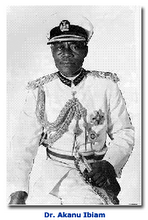
Quite disturbing, typical and indication of a people divided. And when one looks at all the nonsense coming out from Abia and the gang of Orji’s election fraudsters who stole the peoples mandate, one would be wondering if Abia’s really the part of Igboland and origin where prominent Igboist in the likes of Michael I. Okpara, Alvan Ikokwu, Francis Akanu Ibiam and numerous other good men came from.
Until now, Igbo seems not to be getting it, regardless of the ongoing pathetic thirteen years of the nation’s fledgling democracy in the Fourth Republic; that after thirteen years the experiment seems not to be working and an alternative should be sought; which brings to mind Aluko responding to an article I had written years ago giving references to the Holocaust, Apartheid, the Armenian Genocide, the Rwandan Genocide, the Russian Pogrom and Revolution, all all related human atrocities in which the anti-Igbo Pogrom bears the same resemblance, and using the Aburi Accord as an analogy the Nigerian vandals negated; thereby, a sovereign national conference of that nature would not work in a situation no formal apology came forth, effectively. In that regard, I cited sections vii, viii and ix of the Aburi Accord for reference to weigh in the irrelevance of a sovereign national conference. Sections vii, viii and ix of the Aburi Accord:
(vii) With a view to promoting mutual confidence, all decrees or provisions of decrees passed since January 15, 1966, which detracted from the previous powers and positions of the regional governments should be repealed. Law officers of the federation should meet in Benin on January 14, 1967, and list all the decrees or provisions of decrees concerned, so that they may be repealed not later than January 21, 1967, if possible.
(viii) A meeting of Permanent Secretaries of the Ministries of Finance of all the governments in the federation should be convened within two weeks to consider ways and means of resolving the serious problems posed by displaced persons all over the country.
(ix) Displaced civil servants and corporation staff (including daily-paid employees) should continue to be paid their full salaries until March 31, 1967, provided they have not secured alternative employment. The Military Governors of the East, West and Mid-West should send representatives (Police Commissioners) to meet and discuss the problems of recovery of property left behind by displaced persons.
Aluko had written extensively on a working document on behalf of the Yoruba elite, and had concluded it was only principles based on Awoism that would work in a Nigerian entrapment, and considering a modelled Western Nigerian framework, through the profound leadership of Obafemi Awolowo.
At this time in question, Igbo had already been divided on its cause of action in determining if a charter drawn from the various sections of its grouping, suggesting what and what not should be included in the charter. Orabuchi, Francis Elekwachi, Nkem Ekeopara’s “Nd’Igbo Generation 1960-!970, Ralph Uwazuruike’s Movemen for the Actualization of Sovereign State of Biafra (MASSOB), Oguchi Nkwocha’s Biafraland even though he had consistently been against any decision on a Nigerian national state, Okenwa Nwosu, Iselle Obikpani, Ekwe Nche, Enyimba, M.O. Ene’s Kwenu, Cornelius Akubueze and the rest, took part in what had been an arduous task to bring forth a binding document by way of joint sessions with the related factions. Town after town, hamlet after hamlet, village after village, brothers after brothers and cousins both near and far after cousins of the same lineage, raised their voices and said thus far and no further; that Igbo must come up with a charter in the event of an endorsed sovereign national conference, submitting its own line of constitutional guidelines to be deliberated in what the opposing sides had called “conference of sovereign nationalists.”
I had connected with Elekwachi on a series of hiccups relating to the document he had presented on behalf of Pan-Igbo Constituent Assembly in Diaspora (PICAD), the committee he founded in collaboration with Obi Nwakanma, Cornelius Akubueze and others. Elekwachi had commended my insights when the confusion on who is an Igbo and the full definition and meaning of Igbo Proper, which fired up another cycle of debates and symposiums. I had already been exhausted with these debates that had been mind boggling, looking at how the Yoruba nation fair with its stanby, ready made document to keep a Nigerian national state intact and viable.
With respect to what was about to explode among Igbo elites and the ones so distrust of an Igbo charter on the bearings of the document prepared without appropriate and adequate consultations; I gave a deep thought researching and studying the facts and logic about a Igbo Charter to be submitted on behalf of PICAD and a very few other committees. In an exclusive article which was bordered on a profound Igbo national state, putting together analysis and all the stuff detrimental to a healthy Igbo nation, laying empahasis on Igbo as one infinite, indivisible people. Thus I wrote:
“the Igbos are a people whose origin is of one lineage, their genealogies can be traced back through many generations of forefathers to a common ancestor. This type of societal identification is not the same as a national or linguistic grouping. One can join a nation; one can learn a language; both are voluntary. But in blood heritage, it implies Igbos have an inherited customs and traditions which led to a particular order of social organizations. The Igbo of Nando has the same socio-cultural structure as the Igbo of Abakaliki, Ikwere, Obigbo, Nkwerre, Igurita, Okpanam, Ibuzo, Elele, Omoku, Orlu, Abriba, Waawa, Obowu, Nnewi, Idemili, Ihiala, Nsugbe, Amazano, Awkuzu, Nteje, Okigwe, Eziama Obiato, Onitsha and Abagana, Arochukwu, Ohafia, Amaigbo, Arondizuogu, Owerri, Mbaise, Umuohiagu, Oko, Diobu and any community where Igbos can be found. It is in this vast genealogical structure that provided a simple basis for alliances and inheritance. Lands and rights go to sons and brothers on the paternal side. Residential groupings, too, are familial. Villages, kindred and hamlets are made of men descended from a common paternal line women marry in, though many also are of the same paternal line linked by a lineage traceable back to a primal patrilineal ancestor.
So, too, is the traditional way of marriage as no dating occurs when a man expresses his interest in a woman, parents and relatives arrange marriages. As custom dictates, the groom to be has to go through series of interviews and other custom-related events such as paying dowry to the bride to be family before the marriage can be arranged and finalized.
By this order and method, and as we head to the conference table to write a charter for the Igbo nation, we must bear in mind the above particular order when our decisions and resolve begins to climax. We must also bear in mind Igbo nation is a nation state, and that Nigeria must not be included in her principles. In choosing this method, of not including Nigeria or any other entity in her preamble and the entire document, and by not mixing any political principle that varies with the ideals, customs and traditions of Nd'Igbo, treating at great length the needs or rights supposedly appropriate to Igbos everywhere.”
The article was followed by an overwhelming line of commentaries and rejoinders at a time the simmering sovereign national conference proposals had begun to wane, losing steam from a burnt out flame under Obasanjo’s watch and on the premise there was ultimately no need for sovereign national conference as long as a legislature was in existence, a legislature as in all democratic orders to rewrite the constitution through its representatives. The SNC died a natural death the way Obasanjo wanted it.
As the case turned out, the SNC fizzled out for many reasons. Obasanjo, a Yoruba should continue with running the affairs of state, and with the applications of SNC, Obasanjo’s presidency might be jeopardized on the grounds of presiding on a constitution fabricated by the military juntas, and not through normal constitutional conferences procedure. And also, the Yorubas, in respect, should grip firmly on the presidency on the course of its two-term llimitations, and for the first time in the nation’s history, a Yoruba president that could be costly if given away. Obasanjo knew very well the implications of a dim wit sovereign national conference. He alerted his kinsfolk to relax the pace of their desperation based on complications of the agitation on a so-called “better ways to govern ourselves.” Forthwith, Yoruba and Afenifere backed off.
Some weeks ago, I had gone to Town Hall Meeting in my district on related community projects that would create more jobs within the district and with the only community bank in the neigborhood --Union Bank -- and a long standing commitment to help small businesses grow in the community, hoping favorably on the takes of Councilman Bernard Parks (8th District), Councilman Herb Wesson Jr. (10th District), and Mark Ridley Thomas (Supervisor, 2nd District) in a series of ground breaking projects, all in the community.
While exiting the meeting, I bumped into Derek Brown, pastor, the House of Judah Christian Center, who had recognized me from when we met sometime ago in Los Angeles. Brown was classmate to former Kansas City Chiefs running back, Christian “Nigerian Nightmare” Okoye at Azusa Pacific University in Southern California. Brown, later would move on transfer to University of Oregon, Eugene, to finish up his college scholarship sports program. We spoke at length on gists surrounding his college years at Azusa with Okoye, and how Okoye talked him into Igbo dishes which he is now fond of, patronizing West African-related restaurants in Greater Los Angeles, from time to time. Brown had asked where to locate a Nigerian community in Greater Los Angele, and my answer to his question was a capital “Nada!”
Brown and I talked about a whole lot. His days of flirting with Igbo girls in college and all that cultural stuff; how his dates’ brothers and relatives were always around protecting them. He finally gave up as his routine dating became a trend, the frustrating run around, playing hard to get delay tactics. We also talked about politics and the failed African states. We talked about sports in general and how African athletes were shopped for and picked up at Azusa, for professional and international engagements; and one of the reasons Azusa still stands out for its excelling sports programs in small town San Gabriel Valley. Our hangout was a full historical discussion describing the magnitude of our bonding as one, infinite, indivisible people, never mind the past, that we should work in unity because “working together works!”
Igbo is one, infinite, indivisible people!
Ede chaa nam!
I am not the only one who felt the pain that a brother in a new line of attack wants his own brother permanently out of his face.
And I am not the only one who had seen the order from Theodore Ahamefula Orji’s administration in Abia State asking non-indigenes of the state to leave his government office jobs alone drawn from the deadly Boko Haram incidents Vanguard’s Pini Jason called ‘Tufiakwa,’ an outright abomination in Igboland.
I am not the only one who had thought the decision of a 21st Century persecution of a group of people profiled for some inexplicable events I’m yet to fathom, was bizarre and should be condemned in its entirety.
And, for sure, I am not the only one who is seeing the ridiculous measure as a tactic to change its subject, hijacking the peoples mandate to run a regime typical of banana republics.
And what would have amounted to such unimaginable action as a move beyond reasoning by Orji asking non-indigenes in his state to leave his civil service alone?
If this clueless ‘executive’ and his action is not an indication of madness and psychological problems, I don’t know what else is.
After giving a thought to Orji’s weird decision, I had hoped it was like another sensationalized story and, thus have this to say: One, I really hope Orji’s cabinet reverses its decision. Two, I hope the decision is not true and had been taken out of context through its legislative process before becoming law. Three, I hope it’s like one of the practical jokes picked up by the tabloids targeting its reading audience for some cheap shots. Four, if indeed it’s true that Abia State had a plan to sack her own kith and kin from a land that was once one entity and a land once a whole before the mean strategy of divide and rule by the colonization powers and military juntas, Igbo, then, should forget about its own national state. And five, if as it has become true and all the Igbo-related states are now bent, watch the forbidden decision unfold in Abia, and do nothing by way of mass movements - demonstrations, sanctions and other related measures to proclaim Abia a pariah state - Igbo should forget its national state, living as predicted and appears; a peoples disappearing cultural heritage and natural being, coupled with the landscape that identifies it as a national state.
That would mean Igbo is done with its nationhood, eventually. It would mean no such thing as Igbo. It would mean Igbo would be extinct as a people, evolving to a blend of other people, culture and languages. And it would mean what its culturally heritage rivals had haggled on, over time in terms of its exceptional culture and tradition, that Igbo never had a unique culture, was never distinct as had been thought, which evidently had become the simple truth.
It is pointblank in this regard that no one should come after me as in the past on my essays, reports and views which caused all sorts of outrage from related events over time, and the analysis following the thoughts I had penned into perspective; issues concerning Nd’Igbo and how to screw in the nuts and bolts needed for a permanently structured place, appropriately. As those thought-provoking papers were directed toward effective leadership which had been lacking, measuring the capability and the capacity of the seriousness in which organized people gets things done. Even though it came with reasonable and logical responses from a very few on the subject matter, many, beyond imagination, chipped in with their ideological views, unrelated and incoherent to the topic in question with quantities of angry mail that flooded my mail box. Some of the bunch were sociological anger by its expression. “Who is it you are writing for?” How much are they paying you for all these your write-ups?” “You have been sent to destroy my political career.” “When you collect, you write good and when you don’t collect, you criticize.” “What did Nd’Igbo do to you?” “I like the way you write but people are complaining that you only criticize Nd’Igbo,” read some of the angry mails and comments.
And with all that hate mails popped out due to the magic pen I had used to write about a peoples social ills, not too many are now raising hell to the line of profiling, bigotry and hatred instituted by the government of Abia State on a people it shares the same lineage. A people culturally and linguistically bonded. A people known to have shared the same ancestors. A people commonly bonded by way of its worship until the advent of the missionaries and the colonial mandates; and a people that have lived, prayed and worked together for onward objectivity.
Many are now tight-lipped for having nothing to say on a variety of reasons - not wanting to be disturbed - being preoccupied with personal obligations, got bills to pay, not the one to fix Igbo problems, none of “my” business and besides, “they should put their own acts together,” and things like that.
Many do not want it mentioned in their face, the in-your-face kind of attitude, for problems heavily accumulated and problems requiring little or nothing, best known to them. Gestured moves like, I don’t have a job and why should I be worried about something that is not going to fetch me a job or pay my bills. Who cares and why couldn’t those non-indigenes stay in their respective states of origin or relocate elsewhere no such laws of eviction exists? Why are all the brouhaha news when there are numerous overwhelming challenges facing them ahead? Why are they in such a bad shape, anyway, and why would all these nonsense stick out when the sitting governor was not legitimately elected in the first place?
Many are moving on, doing their own thing as it pleases them; for their property, life and wealth comes first before any social ills sort of, that will not contribute to their welfare.
Many gave a thought to Abia State’s newest proposition, writing and talking about it as a taboo and should not be allowed to be implemented in the said state; for it would ruin the foundations of Igbo cultural heritage.
And many, as obviously may have been the case, indicated the sanction did not target Igbo indigenes but non Igbo indigenes, and no matter what the decision may have seemed to be, that it included Nd’Igbo on its eviction notice to proclaim the action was not bias, and that realistically, no Igbo had been affected or evicted from the state’s franchise following the strange decision.
Nevertheless, when a government respects the rule of law, upholding democracy its legislative body makes, it should be known that a legislative process in any democratic order involves representations from districts/zones in which proposals are tabled or set in motion for legislation, and when passed on the terms of required figures favoring the proposition which then becomes law, and despite the negating party which may be short of gridlock or fails to garner enough counts to kill such proposition, the yays takes it away, thus making its sponsored motion law, as in all democracies, unless otherwise.
So, as it happened, Abia State in what it had claimed as events that led to evict non indigenes from its governmental offices, the Boko Haram terrorists, it saw threatened the state from its relative bombings elsewhere which ignited the deal of persecution and justifying it with action “timely taken” by Governor Orji.
Persecution had been a classic case of human endeavor. But persecuting a cousin is way out of fashion. I would have been less worried if the Abia State government had been concerned on the mounting pressing problems in the state - widespread scandals of kidnapping, rape, assassinations, civil unrests resulting from related socio-economic problems as part of unending tragedy in the state, rather than its new measure, taking its woes on a people of its kind, moving to where they find life sustainable and comfortable.
In analogy to persecuting people on reasons of faith, language, religion, culture, economics and what have you - the Spanish Inquisition; Adolf Hitler’s persecution of Jews and Gypsies in Europe; and persecutions in related African countries, draws Abia’s “non-indigenes must go” into perspective with a whole lot of questioning, though.
“If we had some sense of shame, I mean even a little, some people called traditional rulers in the state should know they have no business in this matter, and it is totally out of place for them to log unto this dirty side of politicking to champion a cause,” writes Ikenna Emewu (Daily Sun). “So base and inane as this discriminatory policy of a state against its own blood. If indeed, this list of traditional rulers – about 10 of them and some others in the list is real, I really sympathize with the communities they rule.”
The traditional rulers had been something else but total blame should be irrelevant when a cast of administrative personnel lumped together would endorse an arbitrary measure which makes it scary. The traditional rulers, to be precise, are the architects of destruction in Igboland, in every aspect of its civil liberties, even though the enlightened ones among them sit idly and watch these ridiculous measures unfold. What unfolded in Abia State should not be of a “stunning gig “ based on how Ndigbo operates, remarkably with the traditional rulers who have no business in a just, representative and accountability government but the desire to put in monkey wrench to cause havoc in every of its dealings, adding insult to dishonor. And on the claim that Imo was not nice to Nd’Abia on the breaking down and carving out of the state from a previously dissected Eastern Region to East Central State, to Imo State - Yakubu Gowon and Murtala Muhammad military juntas - a plot orchestrated to keep Igbo divided; which should be taken that Abia had declared its isolation from Igbo in its entirety and no longer care..
The point is, nobody seems to be paying attention as to where Orji’s executive order may lead to and when that decision had been to kick the rest of Nd’Igbo out from its civil service, that could also be making a whole lot of stuff clear for Nd’Igbo: that, say, for instance, an Arochukwu is being savagely axed or murdered in the most brutal way, and a fellow Igbo who stood by watch the horrific event take place must not be questioned or blamed in an act of feud across state lines among brothers, because Orji had fired the first shot in what would be a long battle of a brothers war. That when an ethnic slur is rained against an Ngwa at a market square, it would be fine to cheer on remarks of bigotry and hatred, because Orji started it all. That assuming a Bende man got into squabbles of civil unrest in the northern landscapes and about to be lynched for simply being Igbo while an Igbo at the scene could have intervened but didn’t on the grounds of an irrational executive order by Abia State government.
As the list goes, that an Abriba girl happens to be hijacked by a gang of cultist rapists and another Ihiala man was well positioned to have stopped the rapists and wouldn’t do it just to retaliate by way of personal vendetta, getting even as a result of the actions by Abia government against Nd’Igbo. That an Mbano trader could not meet a fellow colleague of Njaba descent on business related talks over pounded yam and ofe olugbo, bitter leaf soup, at an eatery around the block because the restaurateur hails from Ohafia.
Or as we may have discovered the tragic events of our time, that Nd’Igbo whose history has been of political impotence and victims of genocidal campaigns; and all of a sudden, the northern Islamic Jihadists and terrorists begins to sound positively bloodthirsty again, as in the Sharia Debacle of 2000, and had turned en masse against Igbo women, men, children and their properties in another cycle of wanton killings, and demolitions; and as in a new balkanization theory begun by the state of Abia which would justify the gruesome acts of the Islamic “Jihadic” nihilists and hoodlums on the basis “Igbos have no business to where they don’t belong” in supposedly a Nigerian national state having no restrictions on the free movements of peoples.
What message would Abia State be sending to the rest of the nation when it creates a platform encouraging the northern Islamic terrorists that its acts of terrorism is justified for the purpose of deliberately eliminating its own kind by walling.
Igbo, from generations, not even recorded, has been spoken within the borders in predawn Southern Nigerian Protectorate, a colonial schedule by fabrication - Umunede, Agbor, Asaba, Okpanam, Okitipupa, Igurita, Auchi, Lagos, Abeokuta, Omoku, Ikwerre, Ogoni, Bonny, Okirika, Nando, Ugep, Adadama, Degema, Ogoja, Iva Valley, Enugu, Enugu Ukwu, Ohaji, Egbema, Diobu, Yenagoa, Ahoada, Umuapu, Osina, Akokwa, Umuobom, Arondizuogu, Ikot Ekpene, Nsugbe, Otura, Nnewi, Ogidi, Abagana, Obodo Ukwu, Orlu, Amaigbo, Abba, Ore, Benin City, Warri, Abonema, Obigbo, Umuahia, Uzuakoli, Ogbunike and the list goes on and on - identified with its roots, accent, way of life and tradition.
During the Sovereign National Conferences debates upon the birth of the Fourth Republic when Olusegun Obasanjo who came close to death under Sani Abacha’s gulag, was handed the mantle to take over the affairs of state in a fraudulent election conducted by the Abdulsalami Abubakar’s military juntas, series of groups surfaced on ethnic and tribal lines suggesting the necessities of a sovereign national conference as a road map to a working document for the country. Obasanjo singlehandedly killed that motive.
By then, many groups erupted, waxing stronger save for an Igbo-related group, though the late Stanley Macebuh had earlier founded Post Express, first online national newsreel that provided all around the clock news-related analysis to the nation’s readers. It was during this time I was able to connect with my colleagues piecing together stuff for North Carolina-based Chuck Odili who emerged stronger with the Nigerian World website and the Naijanet discussion group which ignited a new political era for the Fourth Republic with political discourse at its best, before folks who joined lately and hijacked the forums to something else, seeking relevance.
It was also then, that every Nigerian sought the Aburi Accord, the first post-independence conference to resolve the nation’s internal strife and would be breached by the federal Nigerian vandals in its quest for genocide and occupation of Igboland.
Mobolaji Aluko, then Yoruba mouthpiece in its social network began corresponding with me with regards to the Aburi Accord.. Aluko lectured at Howard University, Washington, D.C., and had appeared at Nigerian World related political discourse in an attempt to sell his sovereign national conference campaigns to a young, radical audience that declined to buy his product. Aluko, irratical, angry, mischievous and tribally bent political salesman, left the forum, and in a nutshell, created his own website to promote his agenda and the Yoruba ingrained Awoist principles.
The irony during this period a “reborn” nation was seeking its path to a sound democratic order, Igbos were hovering, knowing not what to do until the Dallas Igbo elites, spearheaded by Acho Orabuchi, founded Igbo Forum, a platform that was way overdue and applauded gracefully. As it happened, it would not be long when the rascals would hijack the place ridiculing the place beyond imagination. Igbo Forum and its sister discussion groups never would be the same again, henceforth.
Sadly, as it developed, Igbo happened to have fallen into a country widely known for its philandering politicians reason why nothing works in its endeavor to get things straight - a brutal police and military force, an Islamic “Jihad” terrorists, a murderous gang of militants, a failed state, collapsed culture and corrupt leaders - virtually in everything that is bad, including the churches all across the land purportedly to have followed the Gospels accordingly, but deviated, misinterpreting the Biblical principles, taking the whole concept to a whole new heights and blown out of proportion. And in some of the bizarre cases, they hold their mouth while the congregational leads are engaged taking advantage of their victims, the gullible and vulnerable ones who had been left with no choices, and who are eventually castigated for attempt to destroying God’s House of Worship by seducing and charming these congregational leaders, offering them what they couldn’t refuse. Such has been the dilemma of these congregational worship centers.
Moreover, as these atrocities and moral outrages are been unveiled, taking other parts of the world, for example, the social media have had a part in changing all that - in their leaderships like in Tunisia, Egypt, Libya and now all around the world with Occupy Wall Street, demonstrations, denouncing corporate greed; with an impact already felt and a big ups for digital social media - Facebook, Twitter and other networks.
Are Nd’Igbo using these social media networks effectively?
The answer would be an “absolutely not!” In June of 2010, twenty-eight-year-old Khaled Said from Alexandria, Egypt, was beaten badly by Egyptian Police while witness and several hand held cameras documented the assault. Despite police denial and cover ups by the Egyptian state, contrary evidence was posted by Egyptians on Facebook and Youtube. It was this disturbing development that that twenty-nine-year-old Wael Ghonim, Googles marketing big wig took his expertise to work. He created the Facebook group “We Are All Khalid Said,” for people to join in protest for the case. Ghonim was arrested returning to Egypy from Dubai where he started the movement that eventually ousted Hosni Mubarak. The Internet movement spread elsewhere in the Arab League becoming a phenomenon all around the globe.
Similarly, there has been cases of murder, extra judicial killings in all the Igbo states, corrupt politicians and scores of atrocities all over the land, and yet the only tool left could not be utilized to effect changes as seen in Egypt, Tunisia, Libya, the ongoing strife in Syria, Yemen, and several parts of the globe, using the Internet as a force of change and “liberation.”
The arrival of the rascals at Igbo Forum when Igbo elites took things for granted - the inability to set standards with guidelines for decorum and topics to be posted and discussed relative to current trends on all Igbo-related political debates and engaging the politicians in a sense of belonging to their best in providing the structural needs of the people they had been elected to serve.
While Igbo Forum emerged, its counterparts had already concluded its phase of its charter and ready to present its recommendations to the much, looked forward to Sovereign National Conference. By this time, the forum had begun to fall apart for lack of keeping up its archives resulting from non payment of dues. As it happened, a series of Igbo forums begun to surface since the breakouts wanted to go on to the local level - remotely to their enclaves - Nd’Ngwa Forum, UmuAnambra Forum, ASA-USA Forum, Akah Forum, NdiIgbo Forum, Old Orlu Province, Waawa Forum, Njaba South, World Igbo Forum, Igbo Events, Igbo Worldnet Forum and the list goes on and on.
Quite disturbing, typical and indication of a people divided. And when one looks at all the nonsense coming out from Abia and the gang of Orji’s election fraudsters who stole the peoples mandate, one would be wondering if Abia’s really the part of Igboland and origin where prominent Igboist in the likes of Michael I. Okpara, Alvan Ikokwu, Francis Akanu Ibiam and numerous other good men came from.
Until now, Igbo seems not to be getting it, regardless of the ongoing pathetic thirteen years of the nation’s fledgling democracy in the Fourth Republic; that after thirteen years the experiment seems not to be working and an alternative should be sought; which brings to mind Aluko responding to an article I had written years ago giving references to the Holocaust, Apartheid, the Armenian Genocide, the Rwandan Genocide, the Russian Pogrom and Revolution, all all related human atrocities in which the anti-Igbo Pogrom bears the same resemblance, and using the Aburi Accord as an analogy the Nigerian vandals negated; thereby, a sovereign national conference of that nature would not work in a situation no formal apology came forth, effectively. In that regard, I cited sections vii, viii and ix of the Aburi Accord for reference to weigh in the irrelevance of a sovereign national conference. Sections vii, viii and ix of the Aburi Accord:
(vii) With a view to promoting mutual confidence, all decrees or provisions of decrees passed since January 15, 1966, which detracted from the previous powers and positions of the regional governments should be repealed. Law officers of the federation should meet in Benin on January 14, 1967, and list all the decrees or provisions of decrees concerned, so that they may be repealed not later than January 21, 1967, if possible.
(viii) A meeting of Permanent Secretaries of the Ministries of Finance of all the governments in the federation should be convened within two weeks to consider ways and means of resolving the serious problems posed by displaced persons all over the country.
(ix) Displaced civil servants and corporation staff (including daily-paid employees) should continue to be paid their full salaries until March 31, 1967, provided they have not secured alternative employment. The Military Governors of the East, West and Mid-West should send representatives (Police Commissioners) to meet and discuss the problems of recovery of property left behind by displaced persons.
Aluko had written extensively on a working document on behalf of the Yoruba elite, and had concluded it was only principles based on Awoism that would work in a Nigerian entrapment, and considering a modelled Western Nigerian framework, through the profound leadership of Obafemi Awolowo.
At this time in question, Igbo had already been divided on its cause of action in determining if a charter drawn from the various sections of its grouping, suggesting what and what not should be included in the charter. Orabuchi, Francis Elekwachi, Nkem Ekeopara’s “Nd’Igbo Generation 1960-!970, Ralph Uwazuruike’s Movemen for the Actualization of Sovereign State of Biafra (MASSOB), Oguchi Nkwocha’s Biafraland even though he had consistently been against any decision on a Nigerian national state, Okenwa Nwosu, Iselle Obikpani, Ekwe Nche, Enyimba, M.O. Ene’s Kwenu, Cornelius Akubueze and the rest, took part in what had been an arduous task to bring forth a binding document by way of joint sessions with the related factions. Town after town, hamlet after hamlet, village after village, brothers after brothers and cousins both near and far after cousins of the same lineage, raised their voices and said thus far and no further; that Igbo must come up with a charter in the event of an endorsed sovereign national conference, submitting its own line of constitutional guidelines to be deliberated in what the opposing sides had called “conference of sovereign nationalists.”
I had connected with Elekwachi on a series of hiccups relating to the document he had presented on behalf of Pan-Igbo Constituent Assembly in Diaspora (PICAD), the committee he founded in collaboration with Obi Nwakanma, Cornelius Akubueze and others. Elekwachi had commended my insights when the confusion on who is an Igbo and the full definition and meaning of Igbo Proper, which fired up another cycle of debates and symposiums. I had already been exhausted with these debates that had been mind boggling, looking at how the Yoruba nation fair with its stanby, ready made document to keep a Nigerian national state intact and viable.
With respect to what was about to explode among Igbo elites and the ones so distrust of an Igbo charter on the bearings of the document prepared without appropriate and adequate consultations; I gave a deep thought researching and studying the facts and logic about a Igbo Charter to be submitted on behalf of PICAD and a very few other committees. In an exclusive article which was bordered on a profound Igbo national state, putting together analysis and all the stuff detrimental to a healthy Igbo nation, laying empahasis on Igbo as one infinite, indivisible people. Thus I wrote:
“the Igbos are a people whose origin is of one lineage, their genealogies can be traced back through many generations of forefathers to a common ancestor. This type of societal identification is not the same as a national or linguistic grouping. One can join a nation; one can learn a language; both are voluntary. But in blood heritage, it implies Igbos have an inherited customs and traditions which led to a particular order of social organizations. The Igbo of Nando has the same socio-cultural structure as the Igbo of Abakaliki, Ikwere, Obigbo, Nkwerre, Igurita, Okpanam, Ibuzo, Elele, Omoku, Orlu, Abriba, Waawa, Obowu, Nnewi, Idemili, Ihiala, Nsugbe, Amazano, Awkuzu, Nteje, Okigwe, Eziama Obiato, Onitsha and Abagana, Arochukwu, Ohafia, Amaigbo, Arondizuogu, Owerri, Mbaise, Umuohiagu, Oko, Diobu and any community where Igbos can be found. It is in this vast genealogical structure that provided a simple basis for alliances and inheritance. Lands and rights go to sons and brothers on the paternal side. Residential groupings, too, are familial. Villages, kindred and hamlets are made of men descended from a common paternal line women marry in, though many also are of the same paternal line linked by a lineage traceable back to a primal patrilineal ancestor.
So, too, is the traditional way of marriage as no dating occurs when a man expresses his interest in a woman, parents and relatives arrange marriages. As custom dictates, the groom to be has to go through series of interviews and other custom-related events such as paying dowry to the bride to be family before the marriage can be arranged and finalized.
By this order and method, and as we head to the conference table to write a charter for the Igbo nation, we must bear in mind the above particular order when our decisions and resolve begins to climax. We must also bear in mind Igbo nation is a nation state, and that Nigeria must not be included in her principles. In choosing this method, of not including Nigeria or any other entity in her preamble and the entire document, and by not mixing any political principle that varies with the ideals, customs and traditions of Nd'Igbo, treating at great length the needs or rights supposedly appropriate to Igbos everywhere.”
The article was followed by an overwhelming line of commentaries and rejoinders at a time the simmering sovereign national conference proposals had begun to wane, losing steam from a burnt out flame under Obasanjo’s watch and on the premise there was ultimately no need for sovereign national conference as long as a legislature was in existence, a legislature as in all democratic orders to rewrite the constitution through its representatives. The SNC died a natural death the way Obasanjo wanted it.
As the case turned out, the SNC fizzled out for many reasons. Obasanjo, a Yoruba should continue with running the affairs of state, and with the applications of SNC, Obasanjo’s presidency might be jeopardized on the grounds of presiding on a constitution fabricated by the military juntas, and not through normal constitutional conferences procedure. And also, the Yorubas, in respect, should grip firmly on the presidency on the course of its two-term llimitations, and for the first time in the nation’s history, a Yoruba president that could be costly if given away. Obasanjo knew very well the implications of a dim wit sovereign national conference. He alerted his kinsfolk to relax the pace of their desperation based on complications of the agitation on a so-called “better ways to govern ourselves.” Forthwith, Yoruba and Afenifere backed off.
Some weeks ago, I had gone to Town Hall Meeting in my district on related community projects that would create more jobs within the district and with the only community bank in the neigborhood --Union Bank -- and a long standing commitment to help small businesses grow in the community, hoping favorably on the takes of Councilman Bernard Parks (8th District), Councilman Herb Wesson Jr. (10th District), and Mark Ridley Thomas (Supervisor, 2nd District) in a series of ground breaking projects, all in the community.
While exiting the meeting, I bumped into Derek Brown, pastor, the House of Judah Christian Center, who had recognized me from when we met sometime ago in Los Angeles. Brown was classmate to former Kansas City Chiefs running back, Christian “Nigerian Nightmare” Okoye at Azusa Pacific University in Southern California. Brown, later would move on transfer to University of Oregon, Eugene, to finish up his college scholarship sports program. We spoke at length on gists surrounding his college years at Azusa with Okoye, and how Okoye talked him into Igbo dishes which he is now fond of, patronizing West African-related restaurants in Greater Los Angeles, from time to time. Brown had asked where to locate a Nigerian community in Greater Los Angele, and my answer to his question was a capital “Nada!”
Brown and I talked about a whole lot. His days of flirting with Igbo girls in college and all that cultural stuff; how his dates’ brothers and relatives were always around protecting them. He finally gave up as his routine dating became a trend, the frustrating run around, playing hard to get delay tactics. We also talked about politics and the failed African states. We talked about sports in general and how African athletes were shopped for and picked up at Azusa, for professional and international engagements; and one of the reasons Azusa still stands out for its excelling sports programs in small town San Gabriel Valley. Our hangout was a full historical discussion describing the magnitude of our bonding as one, infinite, indivisible people, never mind the past, that we should work in unity because “working together works!”
Igbo is one, infinite, indivisible people!
Ede chaa nam!
Wednesday, October 19, 2011
Indigene, non-indigene in Igbo land? Tufiakwa!
By Pini Jason, Vanguard
LAST August the Governor of Abia State, Chief Theodore Ahamefula Orji issued an order sacking so-called non-indigenes from the public service of Abia State.
In a directive dated August 25, 2011 entitled: “Backloading on Transfer of non-indigene in Abia State Public service to their state of origin,” the Governor directed that all non-indigenes working in the public service of Abia State (including Local Government) be transferred to their states of origin effective from October 1, 2011. To be excluded from this purge are non-indigenes in the tertiary institutions in the state.
Question mark on Igbo politicians
This policy has expectedly drawn appropriate flaks from Igbo nation for those affected by this purge are mostly fellow Igbo. There have also been some sympathisers who have tried to rationalise Governor Orji’s action. The main plank of Orji’s defence rests on the need to pay the newly enacted minimum wage of N18,000.
My view is that the purge is unnecessary, inexcusable and puts a sharp knife through the thin ligature of Igbo unity. It puts a question mark on the penchant of Igbo politicians to cry about marginalization and injustice in the Nigerian nation. I have always suspected such cries as self-serving. Orji’s action proves me right.
For a gregarious people who have been at the forefront of the advocacy for Nigerians who have lived almost all their lives in any part of this country to be accorded citizenship rights, I think this purge is not a very thoughtful one. It has a tendency to backfire as I have read somewhere that Anambra State is retaliating Orji’s action! I hope to God that it is not true.
LAST August the Governor of Abia State, Chief Theodore Ahamefula Orji issued an order sacking so-called non-indigenes from the public service of Abia State.
In a directive dated August 25, 2011 entitled: “Backloading on Transfer of non-indigene in Abia State Public service to their state of origin,” the Governor directed that all non-indigenes working in the public service of Abia State (including Local Government) be transferred to their states of origin effective from October 1, 2011. To be excluded from this purge are non-indigenes in the tertiary institutions in the state.
Question mark on Igbo politicians
This policy has expectedly drawn appropriate flaks from Igbo nation for those affected by this purge are mostly fellow Igbo. There have also been some sympathisers who have tried to rationalise Governor Orji’s action. The main plank of Orji’s defence rests on the need to pay the newly enacted minimum wage of N18,000.
My view is that the purge is unnecessary, inexcusable and puts a sharp knife through the thin ligature of Igbo unity. It puts a question mark on the penchant of Igbo politicians to cry about marginalization and injustice in the Nigerian nation. I have always suspected such cries as self-serving. Orji’s action proves me right.
For a gregarious people who have been at the forefront of the advocacy for Nigerians who have lived almost all their lives in any part of this country to be accorded citizenship rights, I think this purge is not a very thoughtful one. It has a tendency to backfire as I have read somewhere that Anambra State is retaliating Orji’s action! I hope to God that it is not true.
Sunday, September 11, 2011
Jonathan/Okonjo-Iweala: An Unjust Vitriolic

By Orji Kalu, Sun News Online
I read two articles last week, which I found very unsettling, unnecessary and unwarranted. One was an attack on President Goodluck Jonathan for the recent detention and release of some members of the Movement for Sovereign State of Biafra (MASSOB).
The other was an acerbic attack on the Minister for Finance, Mrs. Ngozi Okonjo-Iweala, whose second coming is attracting undue flakes from some people. I must confess that both articles have, up till this moment, left me disconsolate. Author of one of the articles in question was pointblank and unequivocal in his condemnation of the manner the arrest was handled, and how the Federal Government gaffed by allowing the President openly and personally announced the release of the MASSOB members. According to them, the president should have directed the Inspector General of Police (who arrested and detained the men) to order their release.
In my thinking, there was nothing wrong with the president ordering their release, after all the appeals to have them released by prominent Igbo sons and daughters were made directly to him. If he had asked IGP Ringim to announce the release, then the publicity mileage accruing from that action would have gone to Ringim. In such a political game what determines which direction an action goes is what each player stands to gain. In this case the president stood to gain, and he ingenuously went for it.
Can anybody authoritatively say that the president ordered the arrest of the MASSOB men? I was pleased with the dissection done on the matter by a columnist in one of the national papers. The author in question though sympathetic to the cause of the MASSOB members outright condemned the arrest and burrowed into the possible consequences of what had happened. His position was that the arrest of the men, whom he described as innocuous and harmless, was an unnecessary overheating of the polity. I agree no less.
But I was particularly moved by the request made to the Secretary to the Government of the Federation, Anyim Pius Anyim, by Justice Eze Ozobu to prevail on the president to get the men released, and the helplessness of the top Igbo who serves in the present cabinet in that circumstance. Justice Ozobu was so irked and dismayed by what happened that he literally took the president to task. He almost berated the president for not living up to the expectation of Igbo who voted massively for him during the last presidential election by not allowing the men to be arrested in the first place.
Even though Justice Ozobu might be justified in his assessment of the evolving situation, I am quick to point out that the president does not owe anybody any allegiance. His allegiance is strictly to the Federal Republic of Nigeria, which he has sworn to defend. Did Jonathan sign any agreement with tribal group in the country that he would shield them from arrest if they broke the law or did anything antithetical to the sovereignty and unity of Nigeria? I believe that the president would not be naive to make such a wild commitment. He approached Igbo leaders who, in their own assessment, saw him as the best candidate that would meet the aspirations of Nigerians and therefore voted for him. That action never meant at any time material that the president would kowtow to such people.
Those who try to hold the president responsible for the arrest and detention of the MASSOB members are not being fair and reasonable. Whoever is familiar with the operations of government would agree that the president might not necessarily have to be contacted before somebody who breaks the law is arrested and detained. To me, the blames for the detention of the MASSOB members should be heaped on the doorsteps of the security agents that masterminded their arrest in the first place.
Dragging Jonathan into the whole imbroglio is an undue distraction. The president has too much already in his hands to be so distracted. He may have his own limitations as a person, but that is not enough to crucify him as is being done at the moment.
As much as I love Igbo and am ready to continue to fight for their cause, as I have always done, I will never support undue sentimentalism. Why blame Jonathan simply that Igbo voted for him? Were Igbo the only people that voted for Jonathan and may not be getting what is due to them as compensation for their faithfulness and support? Hausa, Yoruba and other ethnic groups collectively made Jonathan president. He is not the president of one ethnic group, not even the Ijaw – his sanguineous brothers and sisters.
My defense of Jonathan does not mean that the president should not do something reasonable for those that supported him at the elections. He can achieve this by integrating their interests in the overall national development plan without necessarily being loud about it. It is natural for a person to show soft spot for somebody that has shown him friendship and kindness. That is where such a relationship should end - at an official level.
This does not mean that the President should not make deliberate effort to redress the injustices done to the Igbo since the civil war ended. It is no longer news that Igbo have remained an endangered species in the Nigerian nation. I know what the fears of the security agencies are that made them arrest the MASSOB men. They had thought that by stopping them from holding their ceremony planned for the recognition of some of their leaders, especially Dim Chukwuemeka Odumegwu Ojukwu, they would intimidate them into dropping any plot to replicate what Boko Haram is doing in the North. But sincerely speaking, they got it wrong. Igbo, as I have always said, are very peaceful, republican and enterprising. They do not just embark on a struggle without adequate reason. They do not believe that their rightful place in the scheme of things in Nigeria will be achieved by violence. As well-educated, resourceful and humane people Igbo are ready to continue to work for the peace, progress and prosperity of Nigeria, even at their own discomfort. Probably, this is what some people interpret as weakness. For all I know, Igbo are not a weak race. They supported Jonathan not because he is an Igbo man (anybody who alludes to that is just being mischievous). Rather they gave him support because they thought he had all the qualities of the kind of president Nigeria needed at this time. By the way, is there anything wrong for Igbo to choose to support Jonathan for whatever reason best known to them?
I know a time will come when Igbo will assume the presidency of this country without raising a sword. They do not need any rebellion or guerrilla warfare, as some militant groups wage currently, to get the presidency or register their indignation over the way the country is run.
I do not subscribe to the arguments making the rounds in the media that Igbo had blown their chances of clinching the presidency in 2015 because they supported President Jonathan in 2011. Those who make these lame arguments have forgotten that it is only God that makes kings. The emergence of Jonathan as president was purely a mandate actuated by God using man as an instrument. How could Jonathan ordinarily have become president from being an ordinary deputy governor in 1999? There are some people who have spent virtually all their active years on earth seeking the presidency without even making it to the vice presidency position. If it pleases God that Igbo will produce the president in 2015, no man born of a woman can obstruct it.
Sincerely speaking, Jonathan owes Igbo a debt of gratitude for their steadfast support to his administration, even when the situation was hazy. They returned over 97% votes for him in the elections. How he does it is entirely his business.
As indicated in the beginning of this article, the second coming of Okonjo-Iweala as Finance Minister is being criticized for no justifiable reason. Those in the vanguard of this undue media attack claim she is overrated. How realistic is their criticism? How can any rational person claim Okonjo-Iweala – a World Bank Managing Director -is overrated? This is what I mean whenever I write that Nigerians are the architect of their own problems. Instead of commending her courage to accept the ministerial offer to come and salvage the nation’s economy her critics have found pastime in chastising her.
Ordinarily, I would have used my precious time for more useful engagements instead of responding to the chattering of some charlatans. That would have amounted to great disservice to the nation that is currently yearning for honest men and women that would help it regain its lost glory. Have these armchair critics asked themselves why Olusegun Obasanjo – against all odds – sought the services of Okonjo-Iweala as his Finance Minister. Obasanjo was richly convinced that he needed an Okonjo-Iweala if he was to bring out the economy from the doldrums. For true assessors of the performance of that administration she did not fail to deliver. We all were witnesses to the shock the economy experienced when she was moved to the Ministry of Foreign Affairs as minister. The thinking of Obasanjo was that the reassignment of Okonjo-Iweala to the Ministry of Foreign Affairs would help redeem the sagging foreign image of Nigeria.
In any case, the performance of Okonjo-Iweala in the Obasanjo administration was generally perceived as excellent, which was why Jonathan went for her this time round. For those who did not know: Ngozi Okonjo-Iweala is one of the best brains in the World Bank and the management of the bank had publicly acknowledged this on numerous occasions. In fact, it took her extra two months after she was confirmed by the Senate to assume duties. This was because her employers in Washington needed her to tie up a few loose ends before resuming in Abuja. Would anybody say such a woman is not an egghead?
I believe that her appointment will attract visible changes in the way the economy has been run in the past one year and in the end yield sound policies that will translate into gains for the transformation of the lives of the citizens.
What Nigeria needs at this time is sound fiscal policy predicated on pragmatic economic principles. We do not need parlous economic formula that have exacerbated the woes of the nation. With the resumption of Okonjo-Iweala comes quick response from other indices that measure the performance of the economy. This means that within a short time the economy will be on its way to full recovery.
Let me make it very clear: Ngozi Okonjo-Iweala’s offer to serve is coming at a very huge price. Apart from the big pay packet she is leaving behind at the World Bank (this is estimated at $543,000 per annum) she is going to spend sleepless nights working out modalities on how to revitalize the economy. What is the salary of a minister in Nigeria in accordance with the Revenue Mobilization and Fiscal Commission (RMFC) structure? I know it is not up to N5m annually. If that is true, then multiply $543,000 by the current exchange rate of the naira in the international market and you see what I mean. This amount does not include her allowances and other emoluments as a Managing Director in a top financial institution.
I advise her critics to come up with their own answers to the many problems besetting the economy instead of relishing in their devious recreation of trying to damage the reputation of an innocent woman whose only sin is that she accepted the call by her fatherland to help rebuild the battered economy.
As for those criticizing Jonathan for the detention and subsequent release of MASSOB members, let them apply restraint. They should show some patriotism in their attitude to national issues. At this time of our national development, what we need is concerted effort by all Nigerians to find solutions to the endemic problems of terrorism, corruption, poverty, insecurity and greed seeking to destroy the fabric of our dear nation.
For now, let there be ceasefire.
Nd'Igbo Do Not Need Leaders; They Need Opportunities
 By Chris Aniedobe, Business Day
Many have billed the lack of a transcendent Igbo political leader as the Igbo albatross. Those who say that do not understand the Igbos. The Igbos are economically efficient, individualistic, non-ideological, rational, resourceful, and always have been and always will be politically risk averse. The average Igbo man feels that he has the skill, dexterity, perseverance, and luck to dare his own failure or his own success, sometimes in spite of the incipient odds of failure. That is why the Igbos are dispersed throughout Nigeria and the world with each person daring his own failure or success. But that which makes us successful as individuals fails us as a group because group dynamics is not always the sum of the parts that make it up.
Ndigbo are yet to evolve a group leadership model that will work for us. Until we attain such a model, we will not be successful in party politics because politics is a game of platforms. We see political parties as platforms for individual opportunities and not platforms for collective tribal political actions. This attitude has so far characterized our attitude towards politics particularly since 1999.
Although Ndigbo may come together during times of crisis, it probably is best at this point to acknowledge that Igbos do not need leaders, and do not believe in leaders in so far as those leaders do not create economic opportunities for them. That transcendent Igbo political leader may still come about but only in the context of a firm belief that tangible economic opportunities may come from his leadership.
Unfortunately, in the minds of a people that tend not to anchor their fate on their leaders, the failure of our political leaders have tended to reaffirm the belief in the Igbo mindset that so called leaders are really of no tangible consequence in their lives. Many of our so called leaders have shamefacedly exploited their offices for opportunities. Until then, a distributed leadership model, where the average Igbo man is in fact given a material leadership role in a highly coordinated system of known risks and guaranteed rewards may be the best leadership model for Ndigbo at this point in time.
While our political theorists deal with the issue of appropriate leadership models for Ndigbo, it stands as a purely elementary proposition that we do better as wealth creators than as politicians and rather than pursuing illusory political goals, we should expend our efforts at utilizing our superior economic skills for rapid regional economic resurgence of our Region.
But Let Us Just Stop Being Naïve about Nigerian Politics, Power Concedes Nothing without a Demand. It Never Did and it Never Will
The talk of Igbo Presidency 2015 is a distraction by people who have not taken a close qualitative look at Igbo assets. Those who believe that Ndigbo should be President in 2015 on moral grounds alone are offering up cheap political blackmail that rings hollow. To paraphrase Frederick Douglass, if NdiIgbo are not prepared to vigorously struggle for it, there is no point talking about it. Those who profess to favor Nigerian presidency of Igbo extraction and yet depreciate the need for deep agitation on a common political platform are people who want crops without plowing up the ground. They must commit to the struggle all the way with the zeal of the Zikist boys who were prepared for either freedom or death.
Until the will is there to stamp our foot on the ground and be willing to lay down our lives for it, talking about Nigerian Presidency of Igbo extraction in the face of the considerable structural limitations that constrain us is a distraction. The political diffidence of Ndigbo is self-evident. Others have found out what Ndigbo will quietly submit to and know the exact measure of political injustice which can be imposed on Ndigbo and it will continue until they are resisted with carefully orchestrated struggle. Right now the will is not there. Ndigbo are happily foraging for opportunities in a platform independent manner and are engaged in anything but platform oriented struggle. There is nothing wrong with that. There is however, everything wrong with thinking that the Presidency will be conceded to us purely on moral grounds.
Not that Ndigbo do not need political power; it is that we cannot attain political power without a road map and that road map must take into account the structural defects of the Nigerian entity in so far as it has constrained Ndigbo, its largest ethnic group, to less than one sixth of the Federation. That road map must be drawn on the fabrics of true federation and true federalism. The execution of the road map will involve both words and blows; words in the sense that we must be willing to mount consistent and sustained assault on the anomalies in the practice of the Nigerian Constitution that preclude Ndigbo from attaining full rights and benefits of citizenship in their States of domicile; blows in the sense that Ndigbo must be prepared to assert their legal rights of Nigerian citizenship in any manner legal or necessarily legal to ensure that their fundamental rights remain inviolate. In fact, in any well conducted election, Ndigbo have the numbers to vote in an outcome determinative power in States outside Igbo land. This is a bargaining chip that other ethnic groups do not have but it is also a chip that must be well-guarded.
Tuesday, August 30, 2011
Igbo Can't Be President

By CHIDI NNADI, SUN NEWS ONLINE
Former Director-General of the National Orientation Agency, Dr. Ifeanyi Chukwuka has picked holes on the power rotation principle of the ruling Peoples Democratic Party(PDP), saying it was designed to keep the Igbo out of power. Chukwuka, a medical doctor and politician of note, who is now based in the United States of America, also spoke on his political antecedents among other issues. CHIDI NNADI brings the excerpts:
Political tutelage:
When General Ibrahim Babangida dissolved the 13 political parties formed then, and established the National Republican Convention(NRC) and Social Democratic Party (SDP), being a progressive, I quickly registered in the Social Democratic Party (SDP), where I contested and won the state publicity secretary of the SDP in the old Anambra State. Discharging that position with dexterity and unparallel amiability, I became popular with all governments and served in various capacities both in political parties and the government of my state.
At the Jos convention that produced the late Chief MKO Abiola, I won the post of Assistant National Publicity Secretary, but when the convention was cancelled and the re-run election ordered at Abuja Sheraton Hotel, I lost that opportunity to national limelight to the political organogram of the late Alhaji Shehu Yar’Adua. Not deterred by this, I went back to Anambra State, and was later appointed by Dr. Ezeife as cabinet consultant on Health Matters.
Later Colonel Mike Attah appointed me the director general of Bureau of Information and Culture; then Dr. Mbadinuju as Special Adviser on Lands, Survey and Urban Planning, Media and Publicity and Managing Director of ANSEPA. Later, the then President, Chief Obasanjo appointed me the Director General, National Orientation Agency (NOA) when Professor Jerry Gana was the supervising minister. Finally, I worked with Dr. Chris Ngige as Senior Special Assistant on Mobilization and State Orientation.
Passion for politics;
Regrettably, politics has not at all times presented a bed of roses for me. My worst period in politics was when I was dropped as the DG of NOA in Abuja. No sooner was I appointed to the job of orientation than that appointment was lost in a mysterious circumstance which till today remains inexplicable to me. All I know was that my Personal Assistant continued to warn me to hide my intelligence, that Abuja politics is not Anambra politics. Of course, I ignored him to my own detriment.
Yes, Abuja politics is dirty. If you are smart, you will be schemed out of the system. They need idiots, half-baked fools, embryonic politicians that are initiative barren. They hate those who are inherently endowed with visions and dreams to move this nation forward. This is the political quagmire that has for many years stagnated the progress of this nation. Realizing that the orientator has to be orientated in Abuja politics, my PA bought me a book called “The 48 Laws of Power”, which opened my eyes to the fact that my intelligence will soon have a negative impact and cause me to lose my job.
Categorically, he opined that if he was the president of the country, and witnessed what I did at the podium, he would simply drop whoever was the Minister of Information and immediately appoint me in his place. All my pleas to him to take it easy with me fell on deaf ears. He promised to call my minister to remove me as I was after his job. Surprisingly, two days after that encounter, I lost my job in the most mysterious circumstance. No reason was given. That is Abuja politics and I do not regret the impact I made as DG of NOA. If you go to NOA today, I am well respected. My stay in office was barely a year, but the impact was reverberating and the echo and ripple effect were felt in all nooks and crannies of this nation.
So, at what point did you leave the country and why?
Since Dr. Ngige lost his governorship seat in the court in 2006, I travelled to America to study their system, and also disappear from the scene. Having worked in their hospitals, taught in their nursing schools and taught mathematics in their higher schools, I have come to the conclusion that Nigeria is a country endowed with individuals with high acumen. Our children are by far more intelligent than an average American child in secondary school.
Unfortunately, the country is still dangerously verged on a perilous pathway heading to absolute collapse and decay, if something is not done soon. In 2010, I visited my country from USA where I boasted that Nigeria has more agreeable, sagacious and astute politicians who can’t compromise on issues of nation building than the GOP and Democrats in America. But the level of infrastructural deterioration and decay in almost all sectors of the nation is not only humiliating, but an outrageous insensibility on the part of the government to the plights of the common man of this nation that voted them into power.
Impressions about Nigeria;
Let me begin with the road infrastructure. From Shagamu to Benin, Lagos to Ibadan, Enugu to Abuja, Enugu to Onitsha, Enugu to Port-Harcourt, Enugu to Nsukka, Ore to Ondo to Ife to Ibadan, the roads have been ignored by successive governments of this nation is not only criminal, but wicked. I wonder what is in resurfacing a road. Billions of taxpayers’ money are every year appropriated for these roads and yet nothing tangible is done. It is indeed shameful for anyone to call himself a senator or member of House of Representatives, or president, or governor in this nation when these roads are crying and begging for reconstruction. Obviously, our highways have posed terrible nightmares to commuters and road carnages have assumed an unprecedented dimension in the history of this nation. Consequently, I make bold to suggest that all senators, governors and presidents of this nation should as a matter of criminal negligence to their duties resign their positions if they cannot cater for the people and provide adequate amenities for the citizenry.
When Chief Obasanjo came to power he promised that power outage will be a thing of the past within six months of his being in office. Eight years later, he left the country in a comatose state. Power outage became worse than before. As a matter of fact, no nation can develop technologically when electric supply is not predictable. No industries can be sited or built in this nation when power is on and off. The use of computers for global networking and indeed information processing cannot prosper in a paralyzed energy sector.
Today, Nigeria has the most backward police force the world over. Created to control crime and protect the citizens, our police force unlike what I saw in America, is a caricature of crime control mechanics. With shameful roadblocks mounted here and there, sometimes in every kilometer, the police have reduced their status to mere illegal tollgate collectors, and yet everyone ignores this corruptive tendency. As a matter of fact, the road blocks have achieved nothing in crime control.
The Police Force in this nation is begging for reorganization and should be made lucrative. Government should abolish police barracks and allow police to live in neighborhoods for ease of busting and controlling crime. Since the roads are bad and may not be repaired anytime soon, police should now use power bikes to control crime. They should patrol rather than mount road blocks to collect illegal tolls and cause untold hardship to road users. Government should pay police salaries that are commensurate to the job of crime control and the risk involved. This is common sense. Give the police the necessary equipment and tools to perform their duties and reap the imponderable benefits. We can do it. Yes we can, if we have the will and zeal.
Igbo president project in 2015:
The Igbo are finished politically in this nation. It will be difficult in the present political dispensation for an Igbo man to be the president of this country. The present political computation and permutation as arranged by Chief Obasanjo of the PDP does not favour the Igbo who have been marginalized by Obasanjo’s crafty political equation of South South plus South West plus North Central plus North West equal to a win-win for him. That is why in the PDP National Working Committee, no Igbo man is even appointed a sweeper or a messenger. However, all hope is not lost since the Igbo man is as incompressible as water. We surely will rebound at the appropriate time. We have the capacity, capabilities, ingenuity, sagacity and political maneuver to scale this political man-made hurdle and reintegrate ourselves into the national political stream. We refuse to be condemned and confined to the present political incarceration. Ohanaeze Ndi Igbo should wake up and lead appropriately.
Subscribe to:
Posts (Atom)